Italian National Agency for New Technologies, Energy and Sustainable Economic Development

MEDIA - Press office ENEA
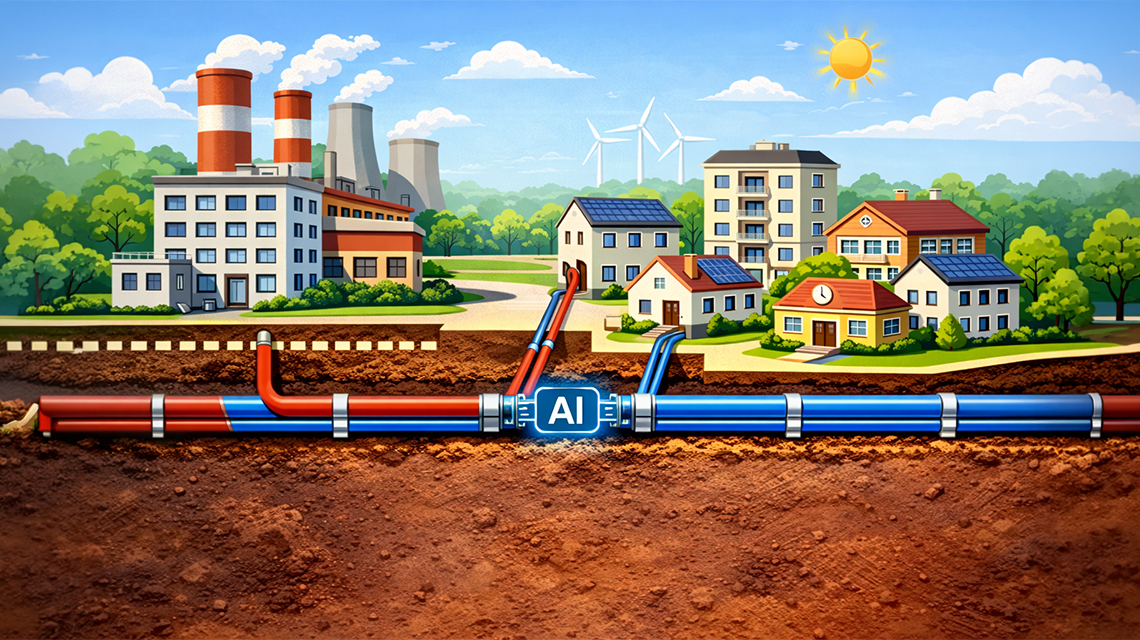
Energy: District heating, ENEA develops AI model for smarter networks
Creating smart district heating networks integrating a growing number of renewable sources thanks to artificial intelligence is the goal of researchers at the ENEA Energy Efficiency Department. They have developed a model based on artificial neural networks capable of predicting, six hours in advance, how much thermal energy a prosumer (a user who is both a producer and a consumer) will be able to feed into the grid. The results, published in the journal Energies, pave the way for the development of increasingly smart district heating systems that mirror modern smart electrical grids.
Developed as part of the 2025-2027 Electric System Research initiative[1], the ENEA model consists of a Long Short-Term Memory (LSTM) neural network—a type of artificial intelligence designed to analyse data that changes over time, like temperature, energy demand or thermal power. “In our case, the network consists of a simple yet effective structure: a single processing layer in which 32 computing units act in parallel to recognize recurring patterns and improve predictive capability” explained Mattia Ricci, a researcher at the ENEA Laboratory for Integrated Solutions for Energy Efficiency and co-author of the study, along with Federico Gianaroli, Marcello Artioli, Simone Beozzo and Paolo Sdringola.
The network developed at ENEA was trained using 13 years of simulation results and hourly meteorological data. Among the variables, outdoor air temperature and solar radiation are fundamental drivers of local, unused renewable heat that can be fed into district heating networks under certain conditions. The model also takes into account the time of day and the time of year, recognizing the daily and seasonal cycles of heat demand and production. “The results we have obtained are promising. The model’s forecasts are sufficiently realiable for short- or very short-term horizons, but we are already working to extend high-accuracy beyond 6 hours” Ricci continued.
Heating and cooling represent nearly half of total energy consumption and still remain heavily dependent on fossil fuels, highlights an urgent need for decarbonization: in 2022, renewable sources covered just 25% of heat production. At the same time, the global transition to renewable energy is accelerating, characterized by a surge in decentralized energy systems, which are becoming increasingly critical, because they enhance flexibility and sustainability through the role of prosumers—users capable of producing, consuming, and sharing energy locally—thereby also facilitating the integration of renewable sources. In this context, district heating and cooling networks play a strategic role: there are approximately 19,000 such networks in operation across Europe, providing heat to over 77 million people, with the highest concentration in Northern European countries, followed by Germany, France, the United Kingdom and the Netherlands.
The European Energy Efficiency Directive 2023/1791 moves in this direction, in line with the Green Deal, promoting efficient district heating systems and the integration of renewable sources and waste heat into heating networks. “District heating networks are in fact recognized as a key solution for supporting the energy transition, particularly in urban areas. Leveraging the synergies between these interconnected infrastructures allows to optimize the overall energy system, promoting more efficient management and contributing to the common goal of reducing emissions” Ricci pointed out.
In recent years, particularly in Northern European countries, the thermal prosumer – an entity that both consumes and produces heat through solar thermal panels or utilizing waste heat– has emerged as a key player on the path toward the decarbonization of district heating networks. Technically, this operation is facilitated by so-called bidirectional substations, that enable two-way thermal energy exchange between a central network and individual consumers.
However, the growing complexity of these networks—characterized by numerous interacting users and variable heat flows—requires advanced technological tools to ensure optimal energy management. “Although artificial neural networks have been widely applied in various fields of energy forecasting, their use in the district heating sector remains relatively limited. Furthermore, most existing research focuses on forecasting thermal demand rather than estimating excess heat production from renewable thermal sources. This highlights a research gap that our work aims to address”, concluded Ricci.