Italian National Agency for New Technologies, Energy and Sustainable Economic Development

MEDIA - Press office ENEA
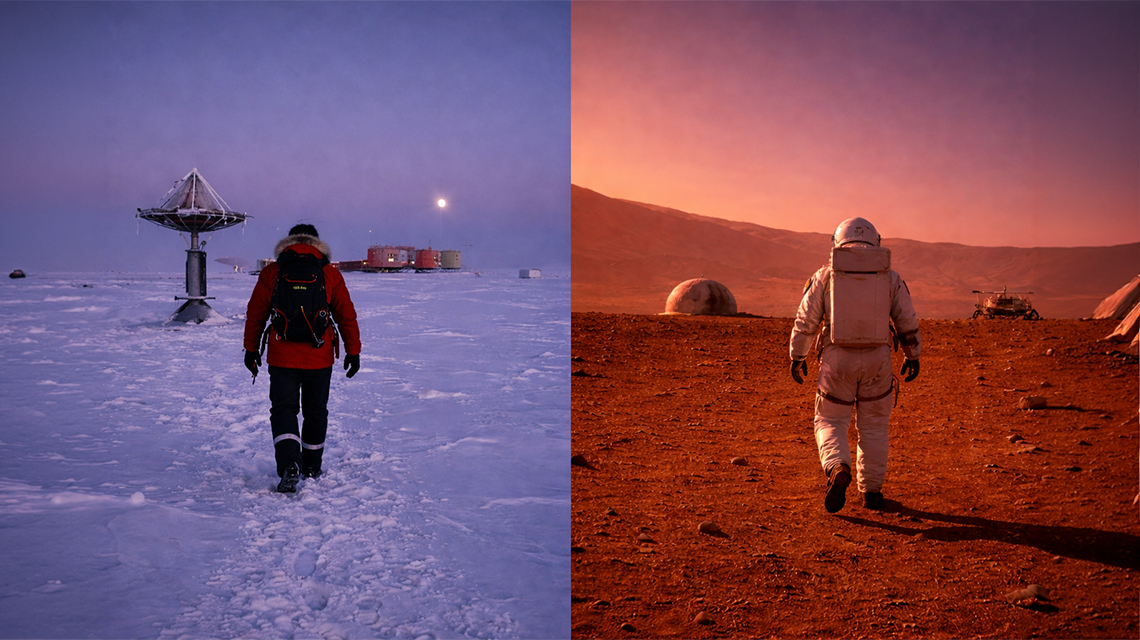
Space: Antarctica, the Concordia Base prepares for human missions on the Moon and Mars
The challenge faced by Antarctic expedition participants, who spend nine months each year in complete isolation at the Italian-French Concordia station, 3,200 meters above sea level, is primarily human as well as technological, according to psychological and biomedical research conducted at the base, which is considered the most remote outpost on the planet, even more inaccessible than the International Space Station.
Managed by the French IPEV and the Italian PNRA [1], for which ENEA manages logistics, the Concordia base has become the best place on Earth to study human adaptation to ICE (Isolated, Confined and Extreme) environments and transfer the knowledge gained from space exploration, also thanks to a twenty-year collaboration with the European Space Agency (ESA).
At Concordia the Winter Over team, composed of 12 people, is preparing for nine months of the Antarctic winter in confined spaces, with limited resources and a hostile environment. This combination of factors creates a scenario that mirrors a future lunar or Martian base, allowing scientists to prepare for the psychological and physical trials of long-term human space exploration.
"Exposure to extreme temperatures, which can drop as low as -80°C, less available oxygen due to high elevation, lack of sunlight for approximately four months, are among the factors which presents severe challenges to human physiology and psychology " said Denise Ferravante, psychologist and ENEA researcher, responsible for the psychological support of the Winter Over team for the PNRA. This year, the team has already been living in complete isolation for approximately two months as part of the 22nd research campaign.
Furthermore, total isolation creates an extreme setting. "Anctarctic winters are characterized by absolutely no possibility of evacuation or supply delivery. Paradoxically, unlike astronauts on the International Space Station that can return to Earth in a few hours, winteroverers at Concordia must rely solely on their own resources" Ferravante continued.
Psychology of Isolation: Social Stress and Adaptation, Forced Coexistence, and Group Dynamics
"Studies suggests that the social dimensioni is critical for long-term coexistence in an isolated environment and in a multicultural group" Ferravante explained. "Differences in age, culture and previous experiences can amplify misunderstandings, disagreements, and intense emotional reactions. Furthermore, during the months of isolation, winter-over syndrome can occur, featuring impaired concentration and memory, nervousness, apathy, depressed mood, irritability and insomnia. These symptoms are also accentuated by the disruption of circadian rhythms related to light-dark periods."
Habitats and social environments characterized by routine and monotony are additional stress factors, equivalent to those to be managed in future long-duration space missions.
"Our studies demonstrate that risks to psychological health can be mitigated by implementing effective countermeasures" said Ferravante. “ It is important to develop targeted personnel selection and training protocols, but also to develop methods to optimize team functioning through communication collaboration and conflict resolution strategies, optimizing affective and cognitive experiences" she concluded .
Psychological research on adaptation to extreme environments, in addition to being crucial for future deep-space missions, may also be useful for groups operating in isolated conditions, like oil rigs and remote scientific bases.
In addition to biomedical research, Concordia Station serves as a a technological testbed for telemedicine, life support systems, energy management and communications in remote environments, due to Antarctica’s hostile conditions which provide an ideal proving ground.
Photo Gallery


Notes
[1]The Italian missions in Antarctica are conducted as part of the National Antarctic Research Program (PNRA), funded by the Ministry of University and Research (MUR) and managed by the National Research Council (CNR) for scientific coordination, by ENEA for the planning and logistical organization of activities at the Antarctic bases, and by the National Institute of Oceanography and Experimental Geophysics (OGS) for the technical and scientific management of the icebreaker Laura Bassi. During winter campaigns, research and maintenance activities are carried out at Concordia.