Italian National Agency for New Technologies, Energy and Sustainable Economic Development

MEDIA - Press office ENEA

Energy: Nanomaterials from rice waste for batteries and supercapacitors
Batteries and supercapacitors [1] made from materials derived from a rice by-product, husk [2], are at the center of research activities [3] conducted by ENEA, Sapienza University of Rome and the Polytechnic University of Turin. The first results, published in the international journals Molecules and Journal of Energy Storage, show that future electrochemical energy storage devices could rely on two innovative nanostructured materials—carbon aerogels and graphene quantum dots—produced from cellulose found in widely available common biomass.
“Carbon aerogels have shown high electrochemical stability, enabling the development of efficient and long-lasting devices. Graphene quantum dots, on the other hand, have proven capable of both storing surface charges and hosting (intercalating) lithium ions within them, showing their potential as an anode material for the development of advanced energy storage systems,” explained the co-author of the study Annalisa Aurora, a researcher at the ENEA Laboratory for Electrochemical Storage Technologies and Devices (Department of Energy Technologies and Renewable Sources).
Carbon aerogel is an innovative, highly porous material often described as a ‘solid sponge’ because, despite having a compact three-dimensional structure, it is made up of over 90% air. This characteristic makes it extremely lightweight and at the same time resistant and electrochemically stable. Composed exclusively of carbon, it’s an element widely used in electrochemical devices in the form of graphite or hard carbon. In its other nanostructured forms (graphene, graphene oxide, nanotubes and quantum dots), carbon can augment its conductive properties and, most importantly, is abundant in plant-based waste.
This study employed carbon aerogel derived from the cellulose contained in rice husks (38% by weight), which underwent a process of gelation, drying and subsequent carbonization. The resulting structure gives the material unique properties, including high electrical conductivity and lightness, making it potentially ideal for batteries and supercapacitors.
“The results of our research indicate that the best performance is achieved with carbon aerogels derived from cellulose gels with the highest concentration of pure cellulose (7%). Although showing lower energy storage capacity compared to other materials, they stand out for their high stability and electrochemical durability even after thousands of cycles,” said Aurora.
"Starting from carbon hydrogel, the researchers were then able to quickly and sustainably produce the so-called graphene quantum dots—tiny graphene particles with a thickness close to a single atom. 'At such a small scale, the material acquires special properties, like the ability to store electrical energy on its surface and facilitate the movement of lithium ions. For this reason, they are considered highly promising zero-dimensional materials, to be explored in combination with other more stable and structured materials for the development of new and more efficient energy storage technologies”, concluded the ENEA researcher.
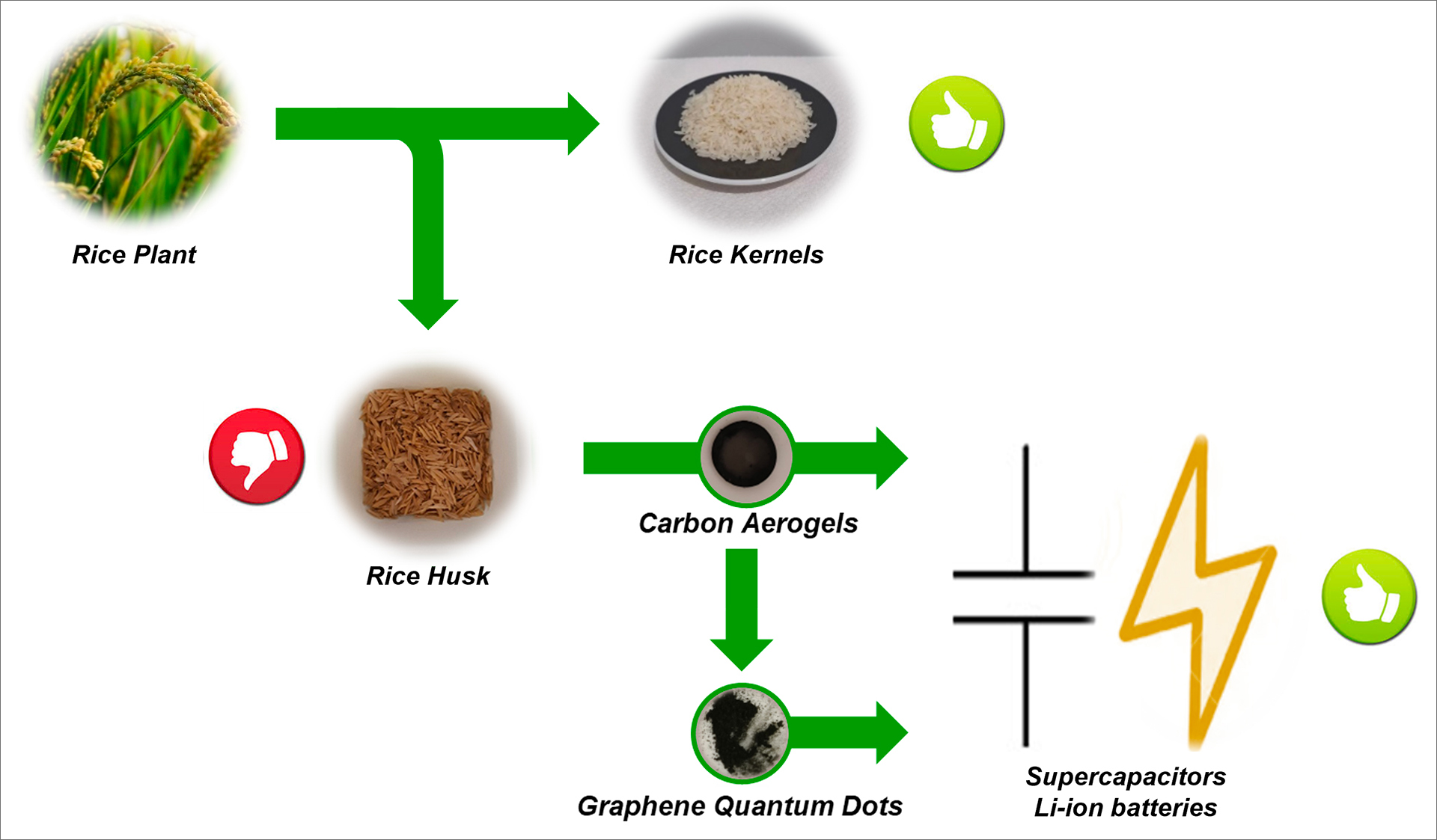
Graphical representation of the process of reusing rice husks in innovative materials for energy storage systems.
Notes
[1] Supercapacitors are devices that store electrical energy like batteries, but they charge and discharge much more rapidly while offering a longer operational lifespan. They are used in electric vehicles, public transportation, electronic devices and energy systems to provide rapid energy delivery or to recover excess energy.
[2] Global rice production is estimated at over 500 million tons, and rice husk constitutes a by-product of its processing accounting for 20% to 33% by weight of dried whole rice. Furthermore, 30–50% of its composition consists of organic carbon. Rice husk has attracted increasing interest in both academic and industrial contexts due to its wide availability, low cost and high potential for conversion into high-quality graphene for technological applications like batteries and supercapacitors. Since 2020, studies on this topic have grown significantly and continue to expand, due to promising prospects in the field of energy transition.
[3] Research activities are partially supported by the 2022–2024 Electric System Research program and conducted through an infrastructure dedicated to the development of innovative technologies for the energy transition and circular economy, named iENTRANCE@ENL, funded under the PNRR framework.