Italian National Agency for New Technologies, Energy and Sustainable Economic Development

MEDIA - Press office ENEA
Energy: a smart summer cooling guide
Key Words: Gradual approach and indoor greenery
To reduce heat-related energy consumption and keep homes cool, ENEA experts recommend taking a “step-by-step” approach, prioritizing more economical and eco-friendly strategies before turning on the air conditioners.
“Summer home comfort and low energy bills don’t depend so much on the power of the systems, but on smart home management” explained Nicolandrea Calabrese, head of the ENEA Laboratory for Energy Efficiency in Buildings and Urban Development.
The first step is utilizing your home’s characteristics by adopting passive cooling solutions to reduce energy demand at the source, balancing three key factors: temperature, humidity, and air quality.
“All exterior openings should be shaded to block the sun’s heat, and any moisture inside the home must be removed immediately. Before cooking or taking a shower, it’s very helpful to open a window to take advantage of natural air currents or, alternatively, turn on the electric exhaust fan and keep it running for at least ten minutes after you’re done” explained Calabrese. “Immediately removing steam,” he said “prevents the air from becoming saturated and moisture from spreading to other rooms. Ventilating rooms and ensuring air exchange also help guarantee good indoor air quality by reducing the concentration of household pollutants and excess moisture”.
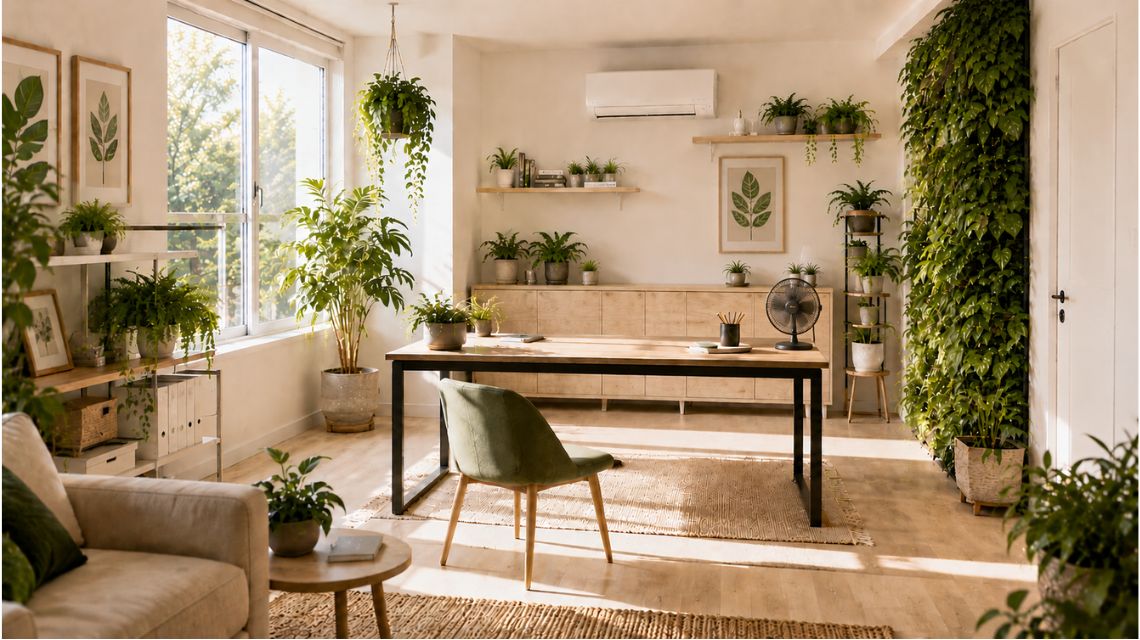
Indoor plants are a natural “ally” of air conditioning systems—and thus of home comfort. Thanks to the natural processes of transpiration and shading, indoor plants help regulate temperature and humidity in the home, optimizing the energy consumption of air conditioners [1].
“Through evapotranspiration, or evaporative cooling, plants naturally draw heat away from the environment, reducing the thermal loads that the air conditioning system must handle” continued Calabrese.
To increase the perceived coolness, it’s best not to place pots separately but grouping plants together in the areas where you spend the most time, thereby generating a much more stable and cooler microclimate. Plants are also useful for creating a sun barrier: when placed in front of windows, they act as natural shields, blocking the sun’s rays before they heat up the rooms. “This reduces the amount of outside air that needs to be brought in and temperature-controlled, promoting energy savings [2],” concluded Calabrese.
If these measures aren’t enough, the next step is to use a fan. This device doesn’t lower the room temperature, but it circulates the air, creating a cooling effect on the skin that can make it feel up to 3°C cooler, with minimal electricity consumption.
Air conditioning should be treated as a last resort and operated following the guidelines recommended by ENEA to maximize environmental benefits, comfort and energy savings:
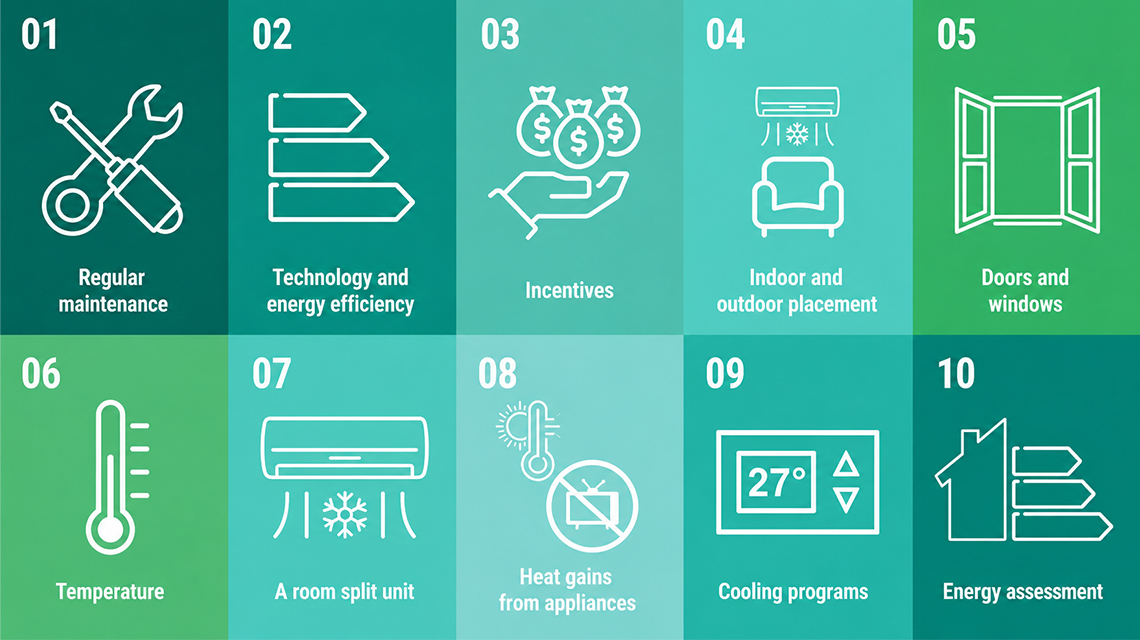
1. Regular Maintenance
The air conditioner requires cleaning and maintenance to function properly, with constant monitoring of the refrigerant circuit pipes, which must be properly insulated. The electricity consumption of a unit operating under strain due to lack of maintenance can be up to 30% higher than factory specifications. In addition to energy consumption, it is important to note that air filters and fans in poorly maintained indoor units are more prone to harboring mold and bacteria harmful to health, including Legionella bacteria, which can be fatal. It is also important to maintain the outdoor unit by keeping the grilles and fans free of dust, leaves, pollen, and smog, which can accumulate over time and reduce the system’s efficiency.
The law requires a system logbook and periodic inspections for systems with a capacity exceeding 12 kW for summer systems and 10 kW for winter systems.
2. Technology and Energy Efficiency Class
Choosing the right air conditioner is important for reducing energy consumption and lowering utility bills. Regardless of the technology, models with an energy efficiency class higher than A are preferable for lower energy consumption and CO2 emissions.
Energy labels for residential air conditioners have been mandatory since 2003 (Directive 2002/31/EC). For split-type air conditioners (units consisting of two components—one inside and one outside the room to be cooled), in addition to the energy efficiency class, the label displays both the seasonal energy efficiency ratio (SEER) in cooling mode and the seasonal coefficient of performance (SCOP) in heating mode: the higher these values, the more efficient the unit. To meet the need to label the increasingly efficient units available on the market, the A+++ to D rating scale has been mandatory since January 1, 2019.
For example, a Class A+++ model will consume up to 40% less electricity than a Class B model.
Air conditioners with inverter control systems are particularly useful if you plan to keep the air conditioner running for many hours at a time. They are more expensive than those equipped with on-off technology, but consume less energy, operate more quietly and provide greater comfort.
The greatest economic benefit can be achieved by combining the system with a photovoltaic system. It is essential to synchronize the air conditioner’s operation with the photovoltaic system’s output, which is at its peak during the middle of the day.
3. Incentives
|
Tax Deduction |
Intervention |
|
50% Home Bonus |
Purchase of air conditioners as part of construction work for renovation or major maintenance on a primary residence |
|
36% Home Bonus |
Purchase of air conditioners as part of renovation or major maintenance work on a second home |
|
50% Ecobonus |
Purchase of high-efficiency heat pump air conditioners to replace a lower-efficiency unit in a primary residence |
|
36% Ecobonus |
Purchase of high-efficiency heat pump air conditioners to replace a lower-efficiency unit in a second home |
For purchases made by December 31, 2026, the “air conditioner bonus” allows you to benefit from a tax deduction of up to 50%
4. Indoor and Outdoor Placement
During installation, it is important to place the indoor unit at the top of the wall: cold air tends to sink and will mix more easily with warm air, which tends to rise. Avoid placing the air conditioner behind sofas or curtains, as this creates a barrier that blocks the flow of cool air. It is also important to ensure that the outdoor unit is not exposed to direct sunlight or the elements, and to leave sufficient clearance (at least 30–50 cm) around the unit to allow for proper air circulation. Plants placed too close, makeshift covers, objects placed in front of grilles and fans, or installations in spaces that are too cramped and enclosed can compromise proper operation and increase energy consumption.
5. Doors and Windows
To block heat before it enters, lower the roller shutters completely or close the blinds on windows exposed to the sun during the day; this simple step reduces the amount of solar energy entering the room by up to 80%, drastically limiting the use of the air conditioner.
The influx of “new” hot air into the room forces the air conditioner to work harder to restore the temperature and humidity to the desired levels, resulting in wasted energy. It’s advisable to open the windows during the cooler hours of the night, when the air conditioner isn’t running.
6. Temperature
Regulations stipulate that during the summer indoor temperatures must not fall below 26 degrees Celsius, but comfort is often ensured even at a higher temperature (two or three degrees lower than the outdoor temperature). Often, simply turning on the “dehumidification” function is enough to prevent the feeling of oppressive heat, since the humidity in the air makes the temperature feel much higher than it actually is.
7. One split unit per room
There’s no point in installing a more powerful air conditioner in the hallway in the hope that it will cool the entire home: the only result will be that you’ll catch a chill every time you walk through the hallway from one room to another, since it will be the only room that’s actually cooled. If the system has multiple split units, it’s best to turn on only the ones you actually need, avoiding cooling unused rooms and keeping the doors to air-conditioned rooms closed to minimize the loss of cool air.
8. Heat Generated by Electronics
During the hottest hours of the day, it’s advisable to limit the use of electronics that contribute to raising the indoor temperature of your home (computers, televisions, appliances, lights).
9. Cooling Schedules and Energy Monitoring
Set the thermostat to a comfortable temperature by creating cooling schedules that optimize energy consumption at night or when you’re away from home. These features allow you to both increase comfort and minimize the time the unit is running. In addition, you can turn the air conditioner on and off remotely and keep it running only for as long as you actually need it. For example, the “night” or “sleep” mode adjusts the room temperature to accommodate changes in body temperature while you sleep. Today, many air conditioners also allow you to monitor the system’s operation via a smartphone app or smart thermostats. These tools let you not only control operating times and modes but also check daily and monthly energy consumption, helping to identify any waste and potential inefficiencies in the system. This makes it possible to detect abnormal situations caused by malfunctions and adopt more sustainable habits.
10. Certification, Diagnostics and Energy Efficiency
The SIAPE has now collected over 7.3 million Energy Performance Certificates (APE) for the residential sector. This means that an increasing number of citizens have access to a useful tool for assessing a property’s overall performance and its estimated energy consumption. With regard to the hot season, the APE includes a simplified graphical assessment of the building’s summer performance, which allows users to see at a glance how well the building envelope protects the interior from summer heat.
If you wish to further investigate the causes of your property’s energy consumption, it is advisable to have a qualified professional conduct an energy audit of the building. This assessment allows for a detailed evaluation of the condition of the thermal insulation and the actual efficiency of the HVAC systems, suggesting targeted improvements to be implemented based on a precise cost-benefit analysis. In addition to reducing summer cooling costs by up to 40%, these structural improvements become even more cost-effective when you take advantage of current tax credits for building energy retrofits.
Efficiency Tips Chart
Notes
[1] ScienceDirect
[2] The study on indoor greenery was conducted in collaboration with Rosita Romeo, a CasaClima consultant and expert in residential comfort. The scientific literature shows that the effects of indoor greenery on thermo-hygrometric comfort, air quality and the mitigation of thermal loads depend on various factors, including the plant species used, vegetation density, light availability, environmental conditions and the arrangement of plants within interior spaces.