Italian National Agency for New Technologies, Energy and Sustainable Economic Development

MEDIA - Press office ENEA
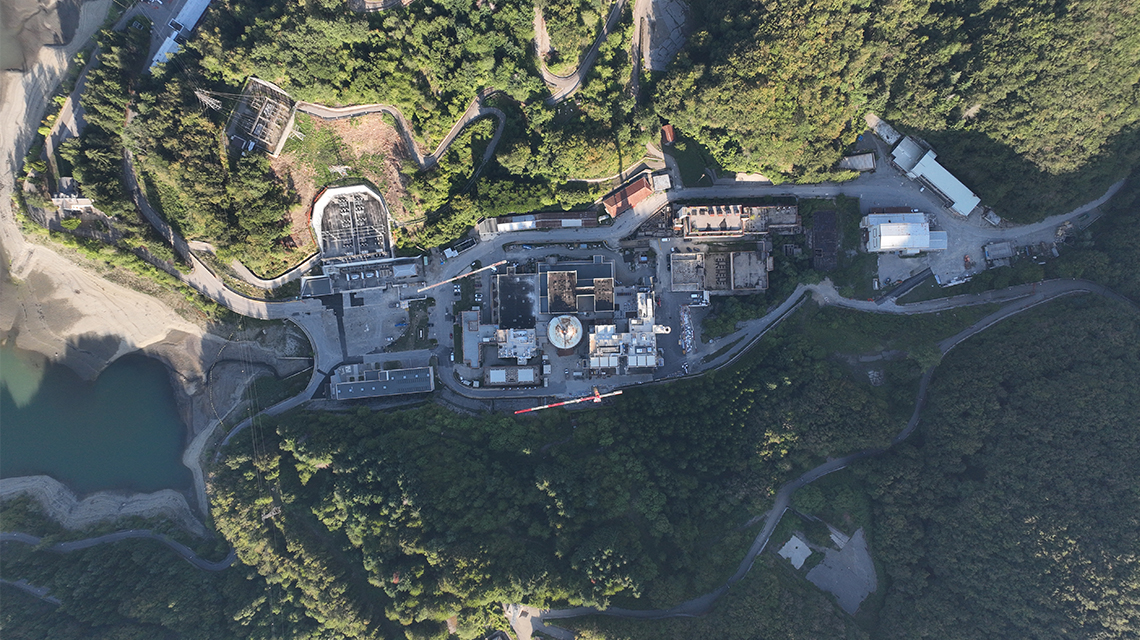
Nuclear fusion: Europe’s largest experimental platform for breeding blanket studies and testing at ENEA Brasimone
W-HYDRA[1], the largest experimental platform in Europe for testing breeding blanket technologies and components under operating conditions, is under construction at the ENEA Brasimone Research Centre (Bologna, Italy). The breeding blanket is the key advanced system surrounding the plasma in future fusion reactors. Developed by ENEA in collaboration with Techfem, a company based in the Marche region, W-HYDRA is part of the initiatives coordinated by the EUROfusion consortium for the development of a fusion demonstration power plant, designed to feed electricity generated through nuclear fusion into the grid.
The platform’s flexible and modular configuration allows different test sections to be integrated and dedicated experimental campaigns to be carried out on different designed components and systems. W-HYDRA will support the development and maturation of innovative technologies, from design through to experimental testing. It will make it possible to simulate operating and accident conditions, collect experimental data, and validate the models and computational codes that will be used in the design of Nuclear future fusion systems.
In particular, the platform will use high-pressure water as a coolant and a lead-lithium alloy for tritium production, in accordance with the European Water-Cooled Lead Lithium (WCLL) concept. The primary system of W-HYDRA is a water loop capable of reaching a pressure of 15.5 MPa[2] and a temperature of 330 °C, conditions comparable to those found in a pressurised water nuclear system. The loop is integrated with a large vacuum chamber, in which an 800kW electron beam will simulate the thermal loads of the first wall of a fusion reactor. The platform also includes a dedicated steam generator test section, designed to investigate its behaviour under the pulsed power operation typical of a fusion reactor, and the LIFUS5/Mod4 platform, dedicated to studying the safety aspects associated with water–lead-lithium interactions.
“With W-HYDRA, we can bring the technology beyond the design stage and put it to the test under real experimental conditions,” Alessandro Del Nevo, Head of ENEA’s Experimental Engineering Division. “W-HYDRA is a flexible experimental platform designed to reproduce operating conditions and transients relevant to next-generation systems and components, including those involving high thermal loads (i.e. plasma facing components). Its value is in its ability to turn experimental testing into data and knowledge that help bring technologies to maturity, from design through to demonstration.”
The construction of the platform has been assigned to Techfem S.p.A., which was awarded the contract for the supply and installation of the main experimental loops and ancillary systems. The contract, launched in July 2026, covers the design, supply, installation, testing and commissioning of the facility, with completion scheduled within two years.
“The construction of W-HYDRA gives us the opportunity to apply our engineering expertise to a nuclear research and development project in collaboration with ENEA,” says Francesco Ganci, Technical Manager for Nuclear Technologies at Techfem. “This is an important experience for Techfem, forming part of the company’s strategy to develop its know-how in the emerging technologies underpinning future decarbonisation pathways. It also provides an opportunity to explore innovative fusion-related technologies while making a tangible contribution to the experimental infrastructure needed to advance their development.”
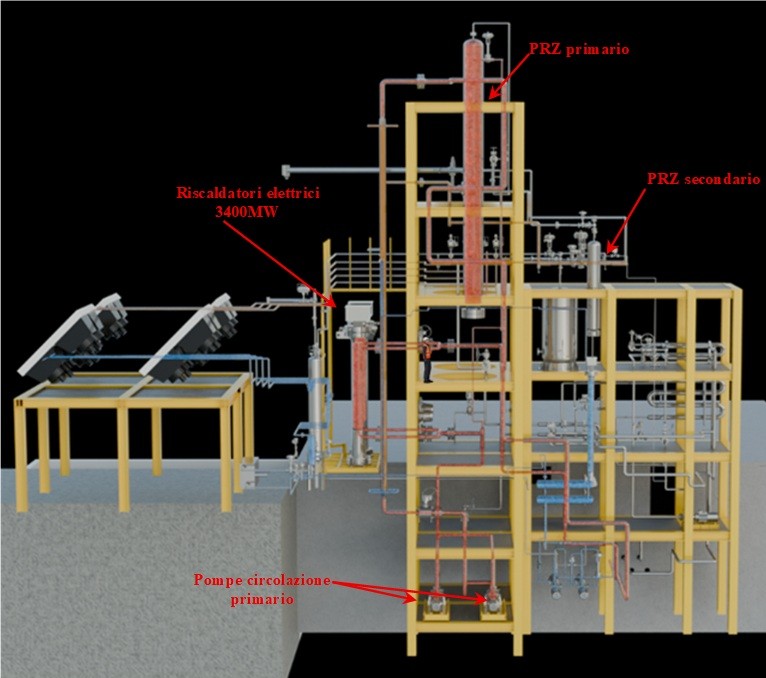
Side view of the main piping systems of the W-HYDRA experimental facility. The primary circuit (Water Loop) is shown in red, while the secondary-circuit steam and the STEAM system condensate are shown in orange and blue, respectively.
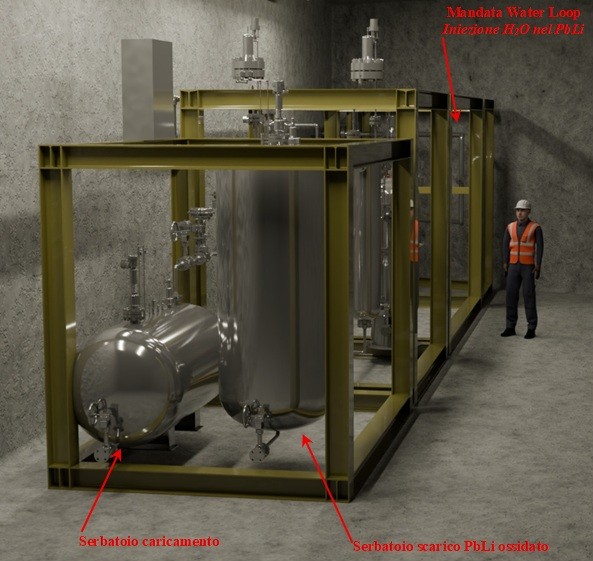
View of the LIFUS5/Mod4 circuit, an integral part of the W-HYDRA experimental facility. The liquid metal loading and discharge tanks are visible in the foreground; on the opposite side is the pressurised hot-water piping of the Water Loop, used for liquid metal–water interaction tests.
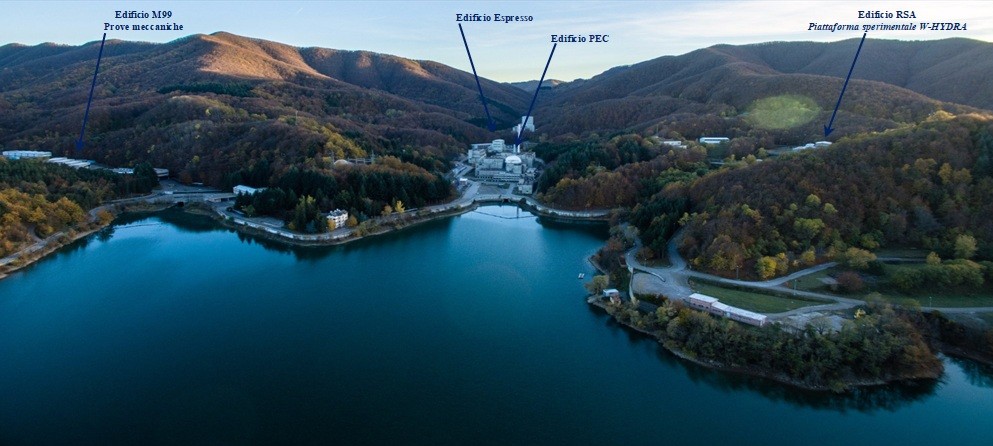
View of the ENEA Brasimone Research Centre. From left to right: the RSA building, where the W-HYDRA experimental facility is under construction; the former PEC reactor building, now housing experimental facilities for nuclear fission; the Espresso building, which hosts facilities dedicated to tritium and lead-lithium (PbLi) technologies; and the M99 building, home to the STORAI mechanical testing laboratory, where the mock-up of the central solenoid for the DTT facility was tested under load and cryogenic conditions.