Italian National Agency for New Technologies, Energy and Sustainable Economic Development

MEDIA - Press office ENEA
Nuclear: Fusion, advanced laser technologies for fuel control in reactors
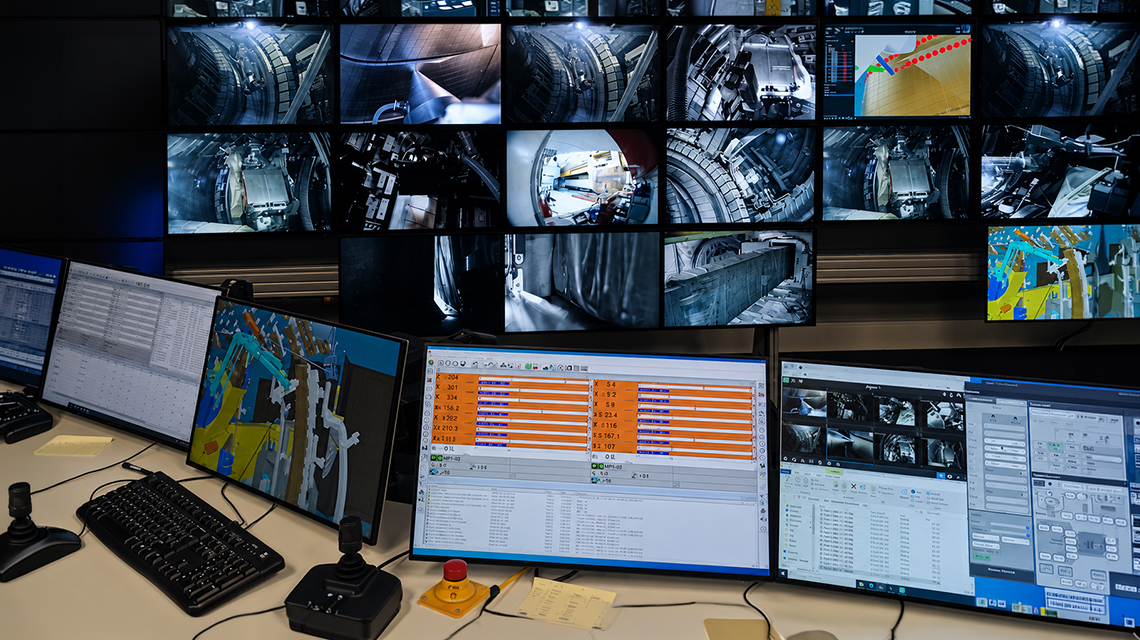
A research team including ENEA has successfully tested two advanced laser technologies at the Joint European Torus (JET), one of the largest experimental nuclear fusion reactors. The goal was to remotely monitor plasma-exposed materials in real time and quantify the fuel (deuterium and tritium) in situ, ensuring the safety and efficiency of future plants.
Funded by the EUROfusion consortium, the experimental campaigns allowed both the tracking of deuterium and tritium deposits and the determination of the chemical composition of the reactor's internal surfaces, without the need for lengthy and complex operations to remove components from the JET vacuum chamber.
These techniques are LIBS and LID-QMS: the former, in addition to monitoring deuterium and tritium on the surfaces of the components exposed to the fusion plasma, provides information on their in-depth chemical composition, verifies any erosion of their surface layers or redeposition of eroded materials from other components inside the vacuum chamber; LID-QMS mass spectrometry, on the other hand, can quantify deuterium, tritium, and even the helium produced by the fusion reaction and 'trapped' in the component under study.
"In future nuclear fusion devices like ITER and DEMO, of which JET was the most representative precursor, a fraction of the fuel will not participate in the fusion process and will deposit on the internal components of the vacuum chamber," explains Salvatore Almaviva, a researcher at the ENEA Nuclear Department at the Frascati Research Center (Rome). "The deposits of this fuel," he adds, "will in the future need to be located and quantified in situ, without the need for lengthy and complex operations to remove the vacuum chamber components, just as was done at the JET facility."
In addition to ENEA, the activity involved the Institute for Plasma Science and Technology of the Italian National Research Council (ISTP), Forschungszentrum Jülich (Germany), VTT Technical Research (Finland), UKAEA - Atomic Energy Authority (United Kingdom), the Polish Institute for Plasma Physics and Laser Microfusion (IPPLM), and the Comenius University (Slovakia), Tartu University (Estonia), and the University of Latvia.
How the two techniques work
These two laser-based techniques are complementary and extremely useful, especially when used synergistically. Laser Induced Breakdown Spectroscopy (LIBS) focuses the laser beam on the sample's surface with a very high power density. This ignites a small local plasma; its spectroscopic analysis—or light "fingerprint"—provides information on the chemical composition of the detected material.
The second technique, Laser Induced Desorption - Quadrupole Mass Spectrometer (LID-QMS), uses a laser to heat the surface of the reactor's internal wall by a few hundred degrees. This causes the phenomenon of "desorption," a process similar to evaporation. The "desorbed" atoms are captured by a mass spectrometer—an instrument capable of distinguishing the mass of the atom or molecule—allowing the quantification of deuterium, tritium, and even the helium produced by the fusion reaction and "trapped" in the component under study.