Italian National Agency for New Technologies, Energy and Sustainable Economic Development

MEDIA - Press office ENEA
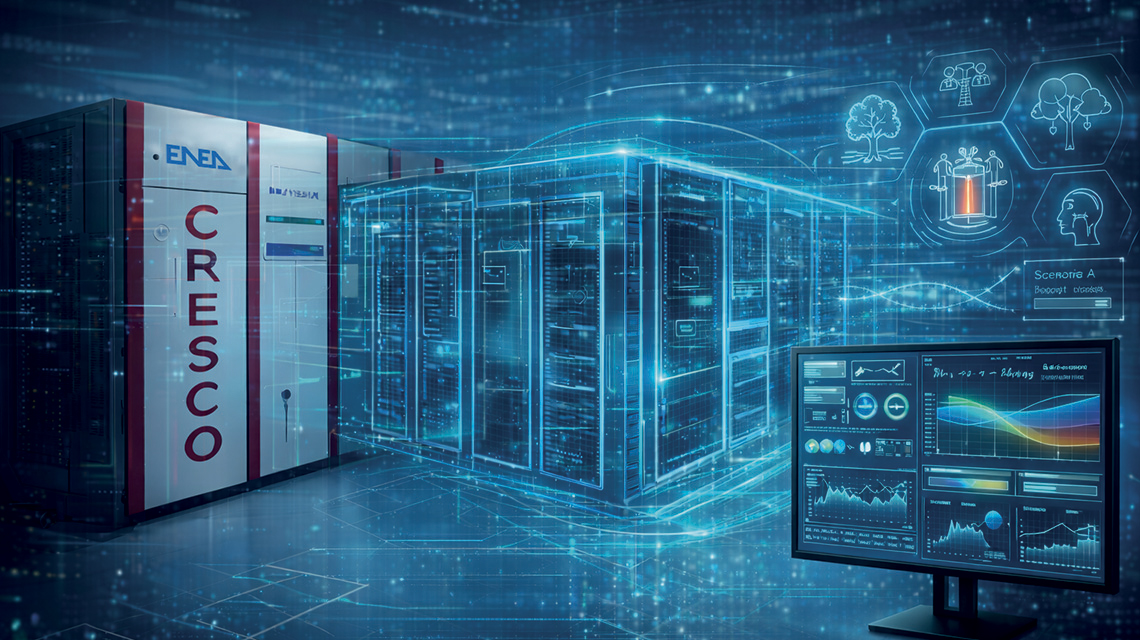
ICT: ENEA develops digital twin of the entire HPC computing infrastructure
ENEA has developed a virtual replica of its entire high-performance computing (HPC) infrastructure [1], including the CRESCO supercomputer at the Portici Research Center (Naples), to monitor physical resources in real time, optimize operations and simulate energy-saving strategies. The activities, presented at various international conferences and published in the online journal Association for Computing Machinery, were carried out as part of the PNRR ‘Rome Technopole’ project.
The CRESCO supercomputer can perform millions of billions of operations per second (petaflops) in various scientific research activities, including: climate change and air quality forecasts; optimization of electricity grids; studies on nuclear fusion and energy efficiency; simulations on innovative materials and nanotechnologies, biotechnologies and health, big data, artificial intelligence and machine learning.
Thanks to the digital twin of the HPC data center, ENEA researchers will have access to new advanced tools to carry out various strategic activities, including: predictive maintenance to detect failures before they compromise operational functionality; energy efficiency, which can be achieved by simulating innovative cooling and workload management solutions; greater resilience of the computing infrastructure, made possible by the processing of failure scenarios and the evaluation of the most effective operational recovery paths.
The system, developed by ENEA in collaboration with the start-up Trakti, combines four advanced technologies: the digital twin, a virtual replica of a physical system, in this case a data center, that allows its operation (energy consumption, cooling, workloads and possible failures) to be monitored, simulated and optimized in real time; the blockchain, which offers a distributed ledger for storing data in securely and immutably linked blocks, ensuring transparency, traceability and reliability; the tokens, i.e., digital units into which data center resources (computing power, memory, and energy) are divided, which are assigned or exchanged between users and projects; digital contracts with legal value recorded on the blockchain (Smart Legal Contracts), which allow for automation and secure regulation of servers, storage and data center network.
"Our digital twin uses artificial intelligence to simulate scenarios, optimize resources, improve fault tolerance and, above all, reduce energy consumption. Finally, it records them on blockchain, thus ensuring the traceability, security and reliability of information and decisions made," explained Marta Chinnici of the ENEA Laboratory for Scientific and High-Performance Computing Infrastructures of the Energy Technologies and Renewable Sources Department at the Portici Research Center (Naples). “Data centers operations and costs will become more transparent and traceable and, in fact, we have already seen a 40% increase in the visibility of costs related to shared resources,” Chinnici said.
Data centers are becoming a pivotal infrastructure for processing and storing the rapidly increasing data, benefiting businesses and citizens alike. However, their rapid expansion poses significant challenges in terms of energy requirements and environmental impact: data centers are estimated to account for approximately 3% of global energy consumption today, with projections indicating a growth of up to 21% by 2030. In terms of emissions, they currently contribute 0.3% to global climate-changing emissions, and are projected to reach 8% by 2030. "With the growth in demand for HPC computing resources, optimization of data center energy consumption becomes a crucial issue. With this activity, we aim to demonstrate the applicability of digital twins to HPC environments, which could soon become a benchmark for sustainable, secure, and intelligent management of critical digital infrastructures" concluded Chinnici.
Notes
[1]ENEA's High Performance Computing (HPC) Data Center has its main hub at the ENEA Research Center in Portici, where the CRESCO 6, 7, and 8 supercomputers are installed, but there are also nodes and support infrastructures in other ENEA research centers (e.g., Frascati and Casaccia near Rome), which are part of the HPC network and collaborate on distributed computing, storage and data management.