Italian National Agency for New Technologies, Energy and Sustainable Economic Development

MEDIA - Press office ENEA
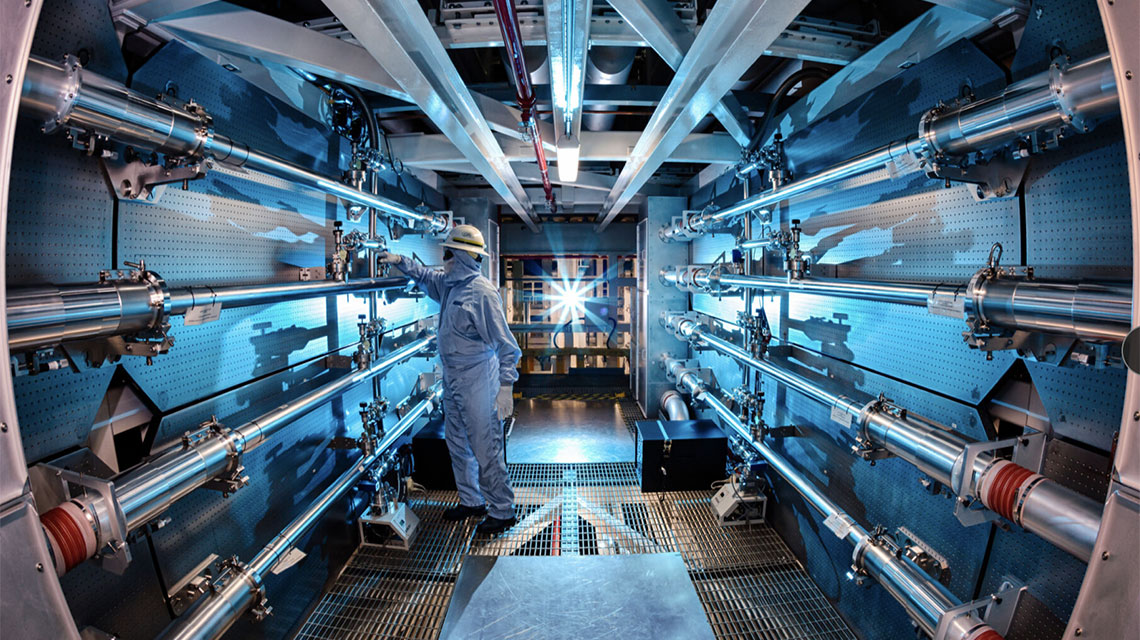
Fusion: Inertial, gamma rays from the first experiment led by an Italian-German team at NIF
Significant progress has been achieved in the field of high-intensity laser–matter interaction and inertial confinement fusion. At the National Ignition Facility (NIF)—the world’s largest and most energetic laser facility, located in the United States and historically dedicated to inertial confinement fusion—a joint European-American research team involving ENEA, University of Frankfurt, the GSI Research Center in Darmstadt and Lawrence Livermore National Laboratory in USA has demonstrated, for the first time, up to a tenfold increase in the efficiency of producing relativistic electrons and gamma photons in the MeV energy range, compared with previous laser–matter interaction experiments. This result was achieved using innovative micro-structured porous materials (foams).
“This represents a major advance in the development of new laser-driven particle and radiation sources, with applications of high importance for diagnostic purposes in inertial confinement fusion and other advanced research fields,” said Fabrizio Consoli, from the ENEA Nuclear Department at the Frascati Research Centre, Principal Investigator, together with Olga Rosmej from University of Frankfurt and GSI, Darmstadt, Germany of the recent NIF-ARC project. “Each experiment at NIF is exquisite and requires months to years of preparations. The precision and fidelity of this laser facility and its experimental diagnostics is unparalleled to achieve novel High Energy Density states, so it is particularly significant that a collaboration led by an Italian-German team has for the first time successfully conducted an experiment there, overcoming an extremely demanding international selection process under the NIF Discovery Science Program.”
Specifically, using the Advanced Radiographic Capability (ARC) laser at NIF, a short pulse laser of relativistic intensity, dedicated to flash the DT capsule at the moment of its implosion, the experiment[1] demonstrated an energy conversion efficiency into relativistic electrons and gamma rays up to ten times greater than previously achieved at the same facility and internationally, thanks to the use of advanced low-density micro-structured materials, known as foams, with densities of only a few milligrams per cubic centimetre.
This achievement builds on years of collaborative work involving several European partners, with experimental campaigns carried out at the PHELIX laser facility at GSI (Germany) and the ABC laser at ENEA Frascati (Italy). It provides a clear example of how access to large-scale facilities such as NIF can be enabled by prior research performed at smaller-scale laser facilities, which allow the development of a robust and well-documented experimental basis.
The ABC laser facility at ENEA Frascati Research Centre is the only installation in Italy capable of conducting inertial fusion studies at laser intensities and temporal regimes comparable to those of NIF, albeit with two beams and at a much smaller energy and scale, and it produces the highest-energy laser pulses in Italy (up to 200 J). The ENEA Task Force INER associated with this facility has been active for more than two decades in research on these innovative materials, combining experimental, theoretical, and diagnostic development work, and holds a leading role internationally.
“ABC is part of the Laserlab-Europe AISBL association, which includes 45 major laser research infrastructures across Europe, and represents a key resource for both the Italian and international scientific and technological community, in both the public and private sectors,” said Mattia Cipriani, researcher in the Task Force INER of the ENEA Nuclear Department and coordinator of the Laserlab-Europe AISBL Expert Group on “Micro- and nano-structured materials for experiments with high-power lasers” focusing on foam materials.
Studies, activities, projects, and recent advances in inertial confinement fusion will be presented at the 21st edition of the Direct Drive and Fast Ignition Workshop (DDFIW), scheduled for 8–11 June 2026 at the ENEA Frascati Research Centre. In particular, on 12 June a satellite meeting of the Workshop will be held, dedicated to the Laserlab-Europe AISBL Expert Group on “Micro- and nano-structured materials for experiments with high-power lasers”
NIF is the largest and most energetic laser facility in the world, consisting of 192 high-energy, high-power laser beams where in 2022, for the first time in history, fusion ignition was achieved, producing more fusion energy out of a fusion reaction than the energy delivered by the lasers driving the experiment. NIF results have steadily improved over the years, with the best experiments producing more than four times the input laser energy (8.6 MJ of fusion energy compared with 2.08 MJ of laser energy).
The news was published on the website of Laser Lab Europe, an international association bringing together 48 laser research infrastructures from 22 European countries:
Notes
[1] Experiment “Ultra-bright MeV photon sources driven by direct laser accelerated (DLA) electrons on ARC,”