Italian National Agency for New Technologies, Energy and Sustainable Economic Development

MEDIA - Press office ENEA
Environment: Toxicity risks from bismuth in freshwater organisms
A study published in the international journal Science of The Total Environment, conducted by ENEA, CNR-IRET (coordinated by researcher Massimo Zacchini), Sapienza University of Rome and the University of Tuscia as part of the PNRR National Biodiversity Future Center (NBFC) project, showed that bismuth, a metal widely regarded as a "green" and low-toxicity alternative to lead, can accumulate in certain aquatic organisms, posing risks for food chain transfer.
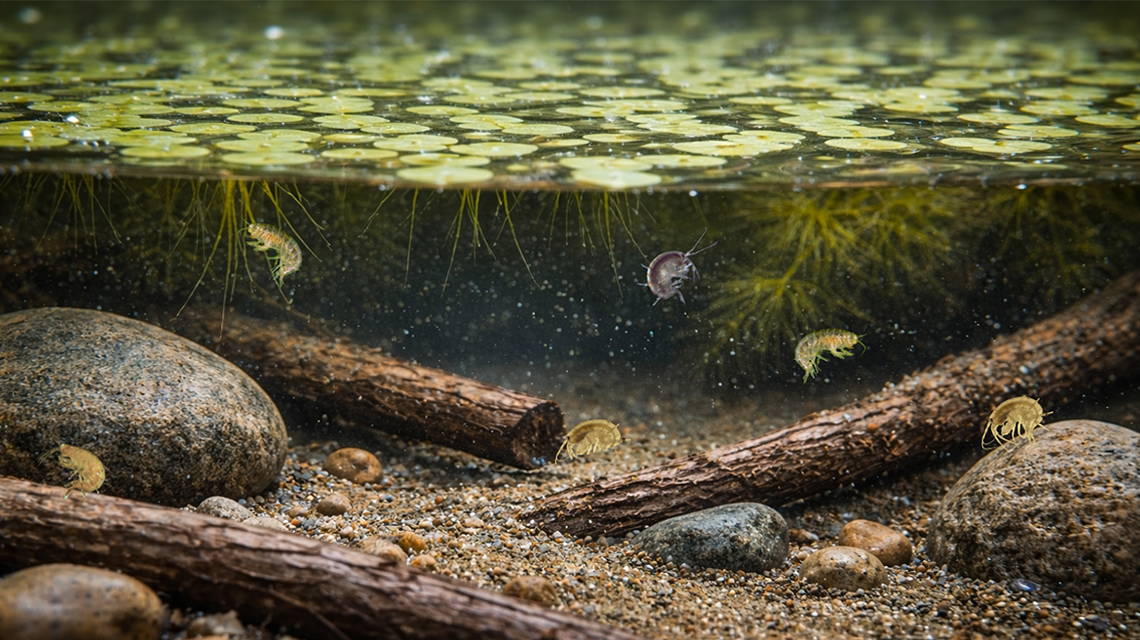
The research assessed the effects of bismuth on two key species used as bioindicators of freshwater ecosystems: Lemna minor, a tiny floating plant known as duckweed that forms characteristic green mats on the surface of ponds and still waters; Echinogammarus veneris, a small amphipod crustacean that plays an essential role in the recycling of organic matter and serves as a food source for fish, amphibians, and birds.
The results show that both organisms accumulate very high levels of bismuth in their tissues, highlighting a potential risk of transfer along the food chain. But there is one key difference. Laboratory tests showed that the Lemna minor plant was more tolerant: even at high concentrations of bismuth, no growth impairment or alterations in the photosynthesis process were observed. “This is the first study on the effects of bismuth in an aquatic plant species and provides the first evidence of a plant’s ability to tolerate high levels of this metal. In the absence of toxic effects, the results suggest that duckweed is capable of activating a mechanism to control metal absorption” explained study co-author Valentina Iannilli, an ENEA researcher at the Biodiversity and Ecosystems Laboratory of the Sustainability Department. “On the contrary” she said “our previous research[1] on terrestrial plants had shown that bismuth can induce toxic effects in the early stages of development. For example, in an edible terrestrial plant like watercress (Lepidium sativum), we observed inhibition of root growth and clear signs of DNA damage even at low concentrations, along with a high capacity for metal bioaccumulation”
The small crustacean Echinogammarus veneris showed DNA damage even at the lowest concentrations tested. “Living in direct contact with sediments, where heavy metals tend to accumulate, these organisms are particularly exposed to bismuth (and other metals): they can ingest particles containing it and absorb it through their bodies, thereby increasing their exposure to and accumulation of the metal” Iannilli continued.
Although bismuth is regarded a low-toxicity metal, new data indicate that it could have sublethal effects on the most sensitive aquatic species, possibly impacting ecosystem balance. The high capacity of the analysed crustaceans to bioaccumulate it, combined with their particular sensitivity to genotoxic effects, makes them effective sentinels for assessing the metal’s toxicity.
The natural concentration of bismuth in the earth is very low (approximately 0.025 parts per million), which is why it is classified as a minor metal. Among the “anthropogenic” sources identified as potential pathways for bismuth entering the environment are dust from industrial and transportation activities, residues from firearms and particulate matter from fireworks. Given its growing use in cosmetics[2] and medicine[3], the occurrence of bismuth in the environment is expected to increase: it has already been detected in Alpine ice, sludge and wastewater from Swedish cities, likely due to the increasing use of cosmetics and plastic products which contain it. “This latter case warrants particular attention, especially considering the use of sludge in the production of biofertilizers for agriculture. Overall, bismuth therefore deserves greater attention as a potential emerging contaminant, both due to its broad and growing range of applications and the ecotoxicological data that are emerging” concluded Iannilli.
Photo Gallery


Notes
[2] In cosmetics, bismuth is primarily used to impart luminosity and a pearlescent effect to powders, foundations and eyeshadows.
[3] Bismuth has long been known for its medicinal properties and is widely used to treat gastric ulcers, burns and malignant tumors. Its use is rapidly increasing in diagnostic medicine as a theranostic agent (i.e., one that combines therapeutic and diagnostic functions), for example, to improve image contrast. In recent years, certain bismuth compounds have also attracted attention in research on broad-spectrum antiviral drugs: experimental studies have indeed shown that bismuth is capable of inhibiting key enzymes of the SARS-CoV coronavirus.