Italian National Agency for New Technologies, Energy and Sustainable Economic Development

MEDIA - Press office ENEA
Environment: ENEA, National phosphorus database crucial tool for a circular economy
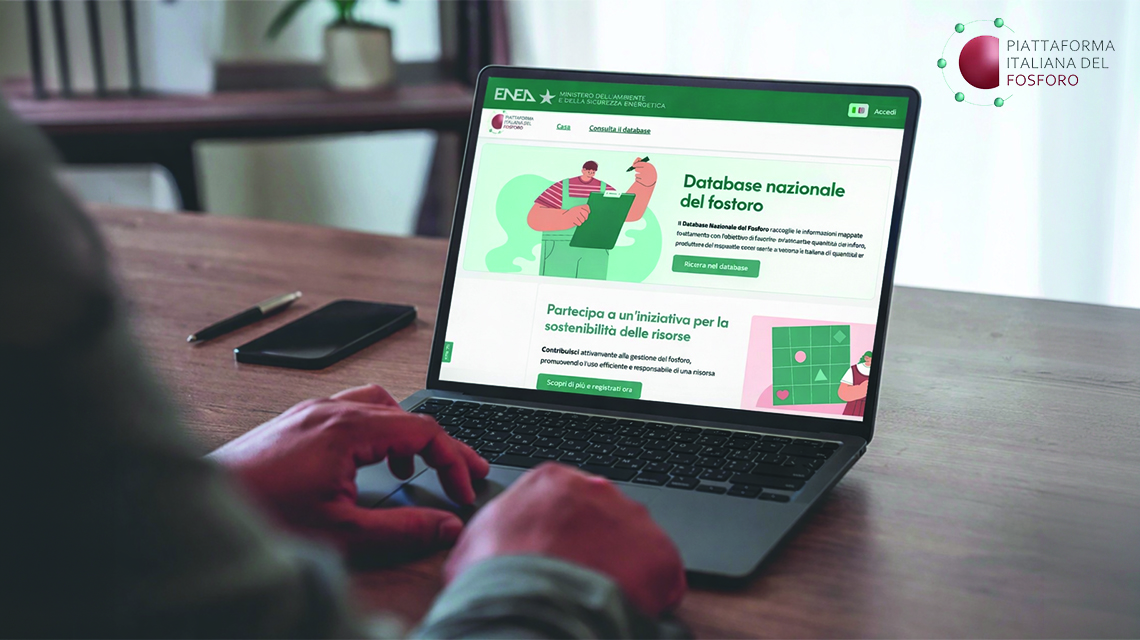
The National Phosphorus Platform, managed by ENEA in collaboration with the Ministry of the Environment and Energy Security (MASE), has developed a National phosphorus database to connect supply with demand for recovered phosphorus as well as questionnaires, best practices and technologies to promote increasingly effective circular economy models and reduce Italy’s dependence on imports.
All the activities were presented at MASE during a workshop organized in collaboration with ENEA. The central theme of the meeting was the secondary phosphorus market and the presentation of the database, which collects information on treatment plants, users and producers of phosphorus-containing waste and residues, with the aim of facilitating a detailed analysis of product needs in terms of quality and quantity.
ENEA has developed a questionnaire for all members of the National Phosphorus Platform with the aim of identifying obstacles and opportunities in the secondary phosphorus market. The results show that Italy has a significant potential to reduce this reliance through circular strategies and domestic recovery, even if the current Italian phosphorus market is vulnerable and dependent on external supplies.
“The National Phosphorus Platform continues to serve as a key hub for sharing knowledge, best practices and technological solutions in support of circular economy policies” pointed out the Platform’s scientific lead, Roberta De Carolis, a researcher at the ENEA Sustainability Department. “The National Phosphorus Database” she said “is an important tool for more efficient, transparent and circular management, enabling more precise identification of needs, flows, and recovery potential, thanks to the integration of data on users, waste producers and treatment facilities”.
Phosphorus is a non-renewable and irreplaceable resource, classified by the European Union as a critical raw material due to its high dependence on imports from non-EU countries (84% for phosphate rock and 100% for elemental phosphorus) and a low recycling rate of end-of-life products (17% for phosphate rock and zero for elemental phosphorus). Despite these characteristics, it is used in many sectors: most of the elemental phosphorus is destined for the chemical industry for the production of agricultural fertilizers, but a growing share is also used in other strategic sectors, particularly in next-generation batteries (lithium-iron-phosphate and lithium-manganese-iron-phosphate), making it a potential key resource for the energy transition.
“Our country has a very low end-of-life recycling rate for phosphorus, which is a critical issue, given that it is classified as a critical raw material by the European Union,” explained Daniela Claps, Head of Strategic Technical Support in the Sustainability Department. “The Platform”, she said, “ has the goal of closing the phosphorus cycle, to reduce import dependence, in line with European priorities for critical raw materials and the principles of the circular economy.”
Established in 2019 at the initiative of MASE, the National Phosphorus Platform aims to achieve national self-sufficiency in the phosphorus cycle and coordinate with European policies by fostering a circular economy. Managed by ENEA in collaboration with MASE Directorate General for the Circular Economy and Land Reclamation, the Platform is open to all entities involved in the phosphorus cycle in various capacities and currently includes over 70 member organizations, including research bodies, public and private institutions, companies and third-sector entities.