Italian National Agency for New Technologies, Energy and Sustainable Economic Development

MEDIA - Press office ENEA
Environment: ENEA in Copernicus consortium for air quality forecasts in Europe
Daily air quality forecasts in Europe with high resolution (up to 3 kilometers), leveraging satellite data from the European Copernicus program and expanding pollen forecasting to enhance allergy prevention, are the main innovations of the new European project CAMS2-40-bis of the Copernicus Atmosphere Monitoring Service. Through this project, the European Center for Medium-Term Weather Forecasts (ECMWF) is continuing its air quality research, conducted by a consortium of 11 partners, including ENEA for Italy, succeeding the previous five-year CAMS2-40 initiative.
The project will produce and make available data on air pollution across Europe and simultaneously work on implementing and updating forecasting systems to the best scientific practices, increasing spatial resolution in forecast models from 10 km to 3-5 km.
"Since 2022, Italy has participated in the European Copernicus air quality program with the ENEA MINNI system, considered among Europe's most reliable, thanks to the high-performance computing power of the ENEA CRESCO supercomputer " pointed out ENEA project manager Massimo D'Isidoro, a researcher inat the Sustainability Department.
MINNI operates alongside 10 other models[1], providing up to 5-days forecasts for air quality and pollen concentration in Europe. Adding up the amount of information made public, we arrive at a daily average of 80 billion data.
All the models in the consortium process standardized input data: pollutant emissions dataset provided by Copernicus and high-resolution weather forecasts from the ECMWF. The results of the eleven systems are then merged into a single ensemble [2], which covers a range of 19 pollutants including ozone, nitrogen dioxide, sulfur dioxide and PM2.5 and PM10 fine dust.
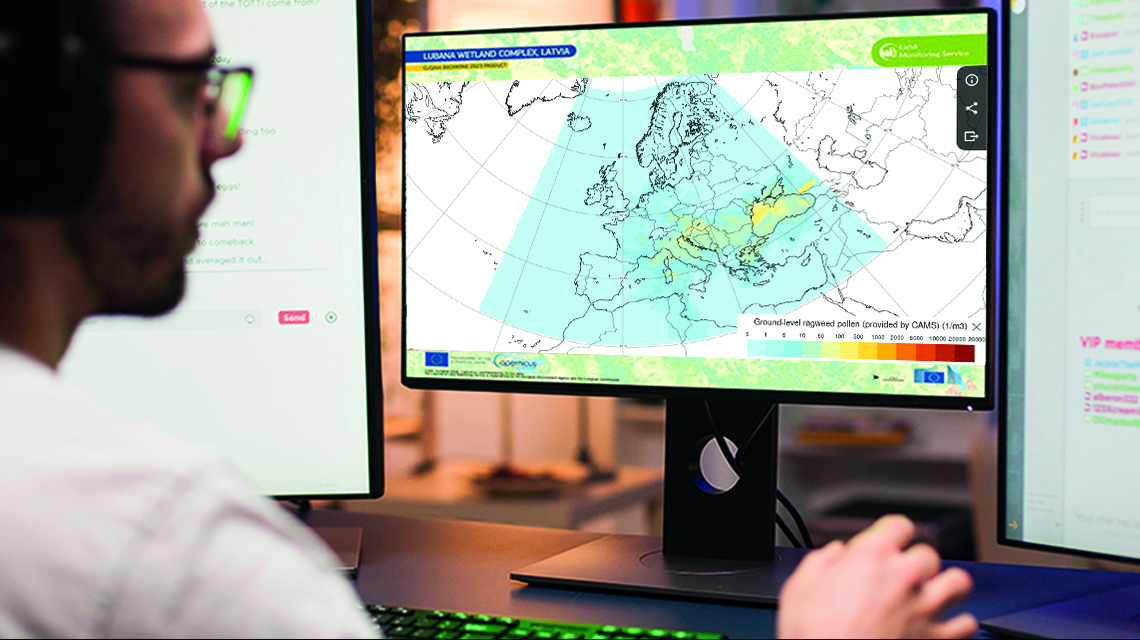
The CAMS2-40-bis project has added to the six species already monitored and forecasted (grasses, olive, birch, alder, ragweed and artemisia) hazel and cypress.
Notes
[1] The models included in the consortium are: CHIMERE by INERIS (France), EMEP by MET Norway (Norway), EURAD-IM by Jülich IEK (Germany), LOTOS-EUROS by KNMI and TNO (Netherlands), MATCH by SMHI (Sweden), MOCAGE by Météo-France (France), SILAM by FMI (Finland), DEHM by Aarhus University (Denmark), GEM-AQ by IEP-NRI (Poland), MONARCH by BSC (Spain) and MINNI by ENEA (Italy).io sono: CHIMERE di INERIS (Francia), EMEP di MET Norway (Norvegia), EURAD-IM di Jülich IEK (Germania), LOTOS-EUROS di KNMI e TNO (Paesi Bassi), MATCH di SMHI (Svezia), MOCAGE di Météo-France (Francia), SILAM di FMI (Finlandia), DEHM di Aarhus University (Danimarca), GEM-AQ di IEP-NRI (Polonia), MONARCH di BSC (Spagna) e MINNI di ENEA (Italia)
[2]Developed by Météo-France and INERIS and made available free of charge in the Atmosphere Data Store.