Italian National Agency for New Technologies, Energy and Sustainable Economic Development

MEDIA - Press office ENEA

Environment: ENEA identifies new soil health indicator
On the occasion of World Soil Day, a study was presented on genetic elements of bacteria that reveal the degree of contamination by antibiotics and heavy metals
ENEA has identified a new indicator of the health of agricultural soils: these are small genetic elements that live inside bacteria, called integrons [1], which host genes resistant to antibiotics and heavy metals, acting as biomarkers of contamination and environmental pressure. The ENEA study, conducted with the University of Tuscia, was published in the journal Agriculture and shows how the structure of these integrons can tell a lot about the health and microbial adaptation of agricultural soils, since they allow microorganisms to acquire, exchange and express those genes that allow rapid adaptation to environmental stressors.
The researchers analysed the change in the structure of integrons in three different environments: digestate (from urban waste and agricultural and food waste), compost and rhizospheric soils, i.e. the portion of soil surrounding plant roots.
"The digestate was the richest in complex and diversified integrons, showing how bacteria can easily acquire or exchange antibiotic resistance genes, making this environment more 'at risk' for the spread of resistance," explained the co-author of the study Andrea Visca, biotechnologist at the ENEA Innovation of agri-food chains Laboratory.
The compost appeared much simpler, showing that high temperatures and maturation processes drastically reduce the complexity of integrons. “For the health of the soil, therefore, compost can be considered a safer soil improver than digestate: its integrons have a simpler, therefore less risky structure, while the wealth of microorganisms it contains can help improve ecological functions and soil health,” pointed out the co-author of the study, Luciana Di Gregorio, a biologist at the same ENEA Laboratory.
Finally, the rhizospheric soils of durum and soft wheat were examined, revealing intermediate characteristics, but with a certain abundance of genes for resistance to heavy metals like chromium, presumably due to the selective pressures linked to the use of agricultural soil improvers or the geochemical composition of the soil itself. "A new and interesting aspect of our studies is that the two wheat species taken into consideration showed differences in the ability to 'model' the microorganisms associated with the roots," pointed out the co-author of the study Manuela Costanzo, biotechnologist at the ENEA Laboratory.
Integrons have already been used in several studies as biomarkers of contamination and environmental pressure, but the ENEA study shows how agronomic management, for example the choice of soil improvers and cultivated varieties, affects not only soil fertility, but also resistance to antibiotics and heavy metals. "The organization and variety of integrons therefore become a sort of 'litmus test' both for monitoring soil health and microbial resilience and for assessing the sustainability of agricultural practices and the risk of spreading antibiotic resistance genes into the environment," said Visca. “ With expectations of agriculture becoming increasingly attentive to soil health and the 'One Health' logic,” she concluded “our study paves the way for new environmental monitoring tools: observing how integrons change could become an efficient method to make safer and more sustainable agronomic choices. One example is digestate which, although a valuable source of nutrients, can act as a potential vector of antimicrobial resistance, requiring further treatment or limited use in the most sensitive areas."
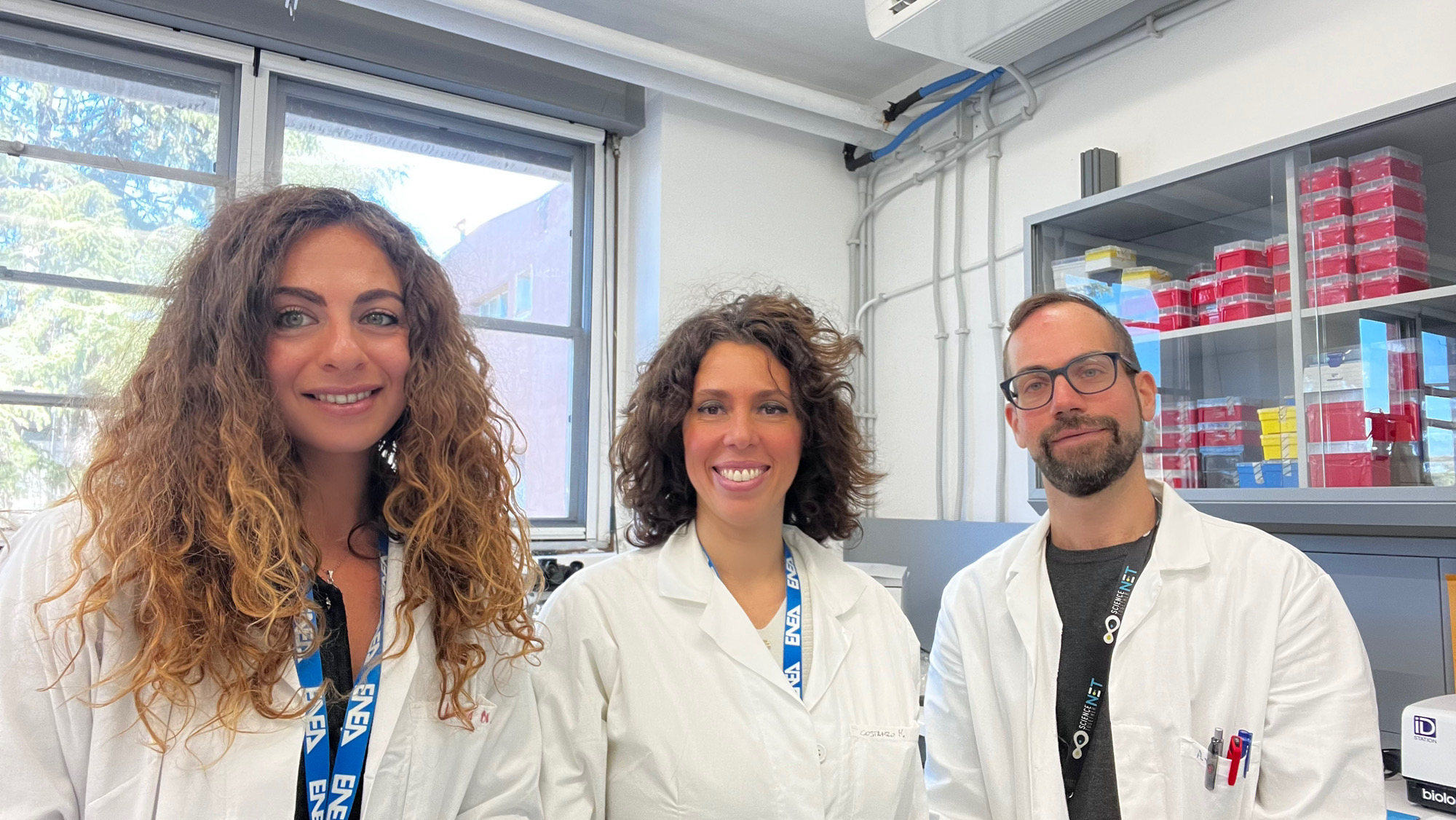
From left: Luciana Di Gregorio, Manuela Costanzo, and Andrea Visca from the ENEA Laboratory for Innovation in Agri-Food Supply Chains.
Notes
[1]Complex integrons represent an evolved form compared to basic integrons: they are characterized by the presence of multiple gene cassettes, often associated with resistance to multiple antibiotics or other adaptive traits. Compared to simpler forms, they exhibit a more intricate genetic architecture, which may include additional regulatory sequences or mobility elements, enabling them to integrate and rearrange genes in a more dynamic manner. This increased complexity enhances their contribution to the genetic plasticity of host bacteria, increasing the potential for the transfer of beneficial genes in environments subjected to selective pressures.