Italian National Agency for New Technologies, Energy and Sustainable Economic Development

MEDIA - Press office ENEA
Environment: Antarctic warming is altering atmospheric stability
Surface warming in Antarctica since 1950, particularly over the Antarctic Peninsula[1],, is significantly altering the stability of the lowest layers of the atmosphere. This is one of the key findings of a study conducted by ENEA together with a group of scientists from six international institutions [2], and published in Journal of Climate.
“The progressive reduction in atmospheric stability near the surface, caused by rising surface temperatures, is increasing the formation of atmospheric gravity waves[3] originating from the Antarctic Peninsula, one of the main ‘factories’ of these waves, which play a crucial role in atmospheric circulation and climate dynamics”, explains the study’s first author, Maria Vittoria Guarino of ENEA’s Climate Modelling Division. “A less stable atmosphere,” she adds, “facilitates the generation and upward propagation of these wave signals. Our research highlights for the first time an increase in these waves and links it to changes in near-surface atmospheric flows.”
The study shows that the effects of surface warming extend beyond the surface, generating more waves that propagate into the stratosphere and beyond, helping to reshape atmospheric circulation, with impacts that extend from local to global scales.
“Atmospheric gravity waves are not just a local phenomenon; they can influence the polar vortex, ozone-related processes, and weather at mid-latitudes. An increase in their occurrence therefore points to potentially profound changes in the dynamics of the Earth’s climate,” Guarino concludes.
The results are based on data from meteorological stations, satellite observations, reanalysis products, and model simulations, all of which show a consistent increase in gravity waves. In December the study was highlighted by the American Meteorological Society among its Early Online Highlights.
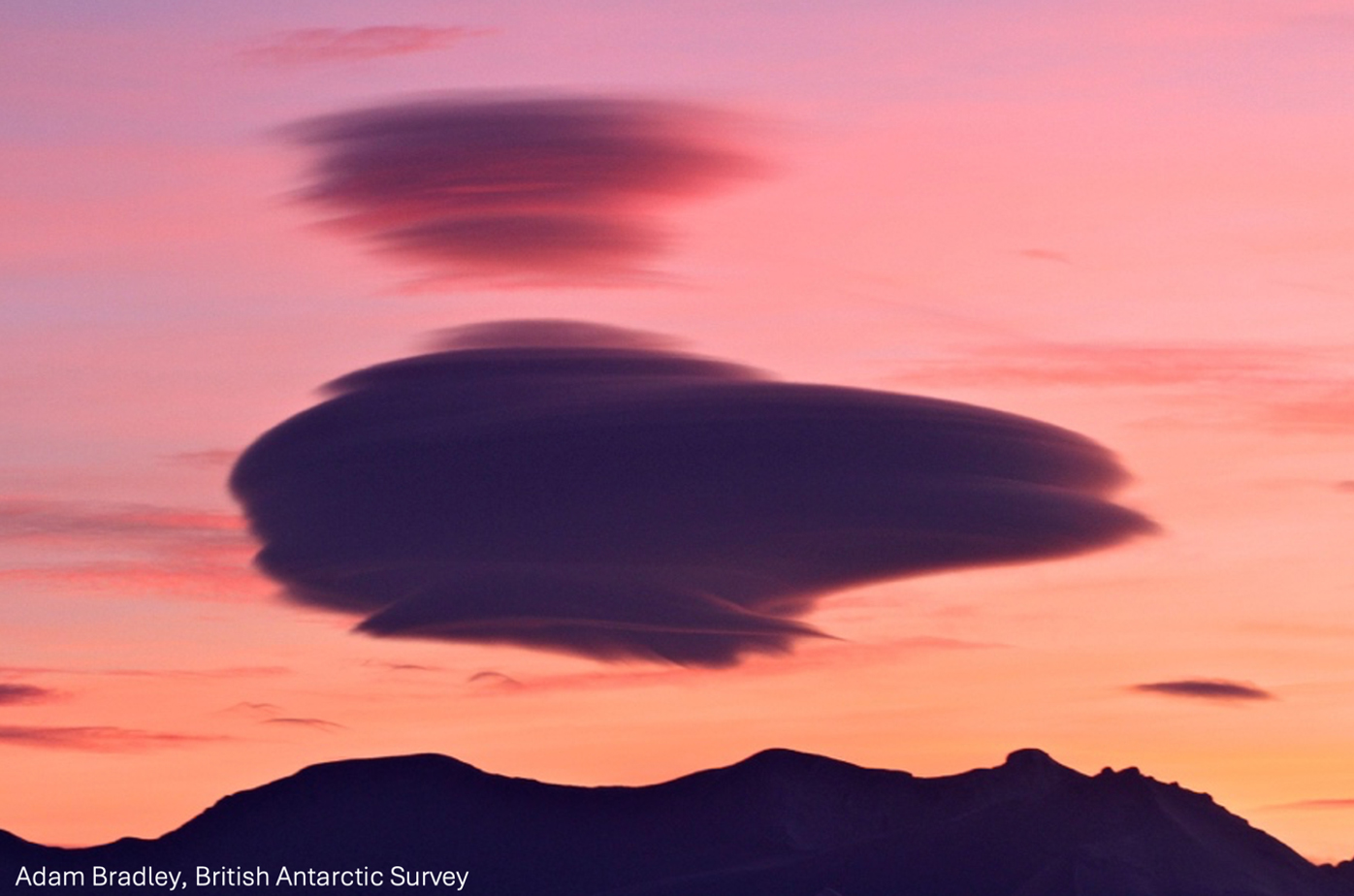
Lenticular clouds over the Antarctic Peninsula’s mountain ranges, created as gravity waves move upward through the atmosphere. Credits: Adam Bradley, British Antarctic Survey.
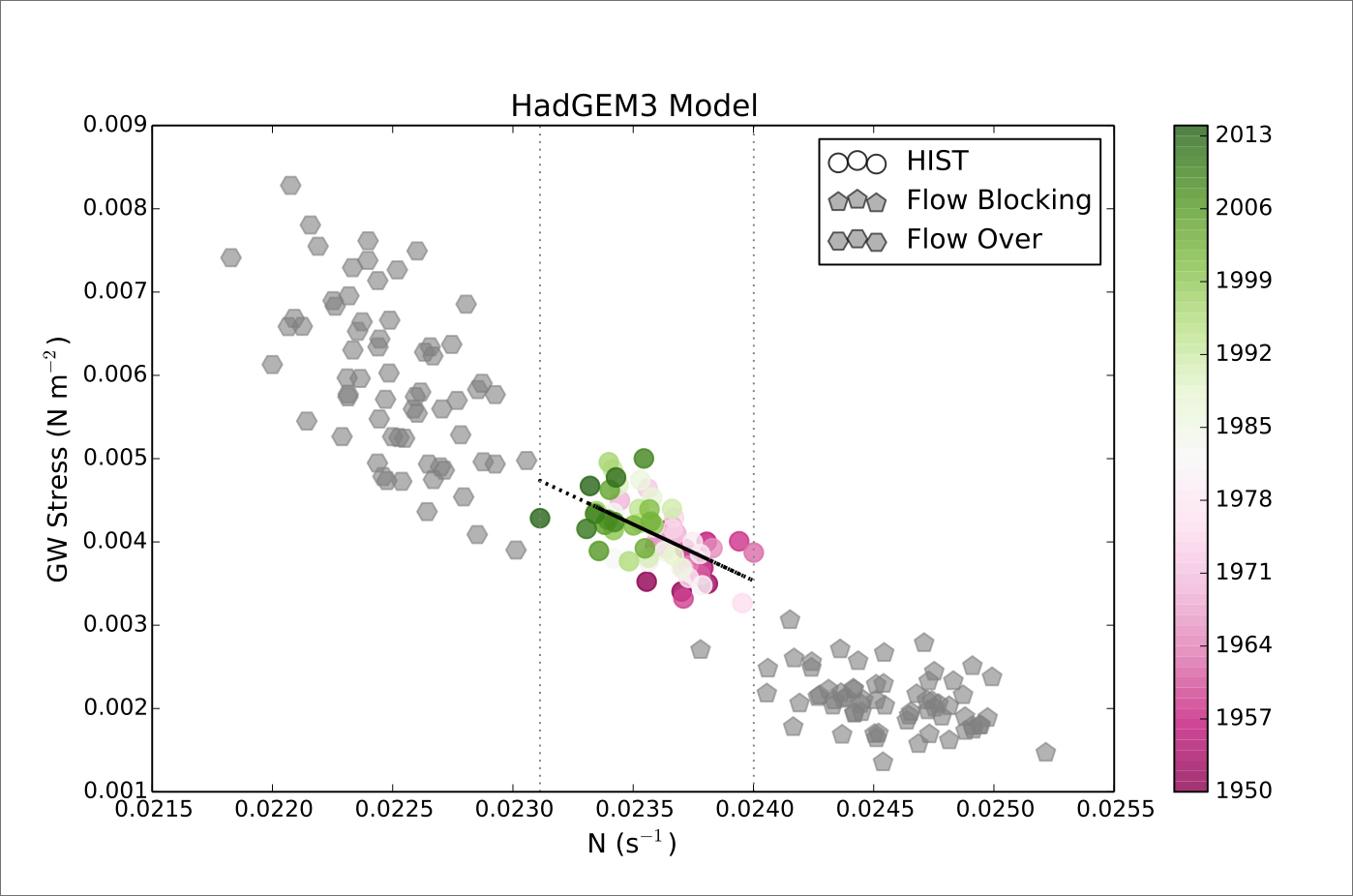
Transition from the ‘FLOW BLOCKING’ to the ‘FLOW OVER’ atmospheric regime during the historical period, from 1950 (purple) to 2015 (green), based on climate model simulations. Guarino et al., J. Clim., 2026.
Notes
[1] The northernmost part of the continent, extending toward South America.
[2] International Centre for Theoretical Physics (Trieste, Italy); British Antarctic Survey (Cambridge, UK), The Met Office (Exeter, UK), University of Bath (Bath, UK), the European Centre for Medium-Range Weather Forecasts (ECMWF, Reading, UK); Laboratoire de Météorologie Dynamique e Sorbonne Université / École Polytechnique (Paris, France).
[3] Atmospheric gravity waves are oscillations in the air that form when an air mass is displaced vertically. Gravity then acts to restore it to its original position, creating a wave-like motion. In the case of the Antarctic Peninsula, the presence of mountain ranges forces the air to rise and descend as it moves over the obstacle, generating waves that can propagate over long distances and reach high altitudes.