Italian National Agency for New Technologies, Energy and Sustainable Economic Development

MEDIA - Press office ENEA
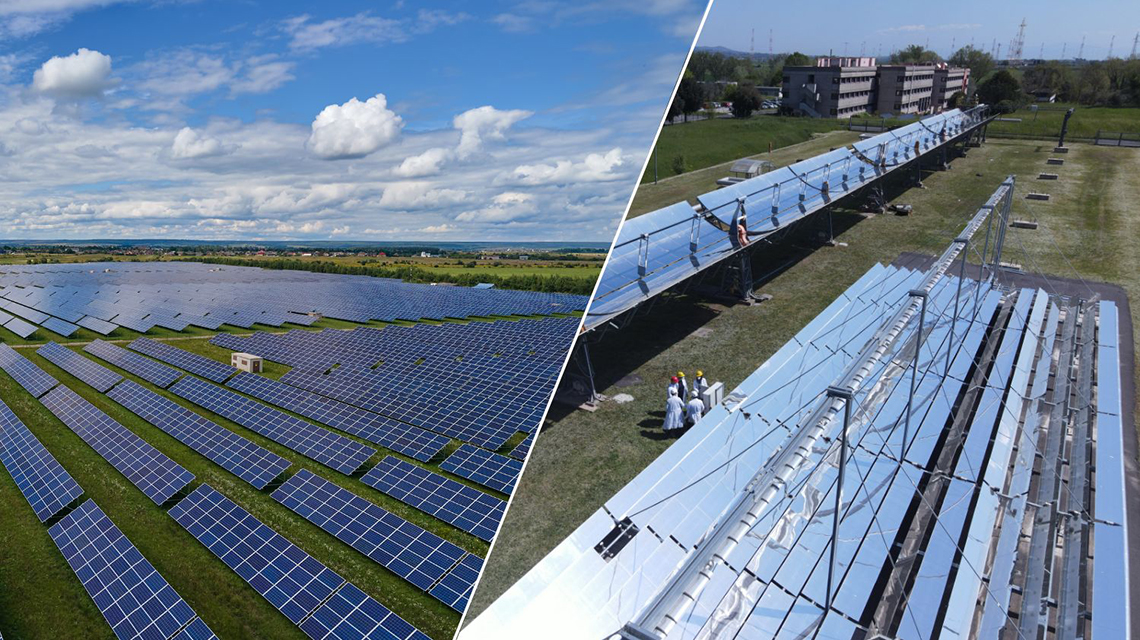
Energy: Photovoltaic and concentrating solar power, a comparison
An ENEA study published in Energies, comparing the performance of the two technologies in four Italian locations, shows how photovoltaics produce more than double the energy per square meter of occupied land compared to concentrating solar power, and is widely considered the ideal technology for a national scale thanks to their ability to exploit the different components of solar radiation (direct, diffuse, and reflected).
Concentrating solar power, which requires high levels of direct solar radiation, is nevertheless very competitive in central and southern regions and, unlike photovoltaics, makes it possible to store thermal energy, ensuring a more programmable and stable electricity production.
The researchers analysed the solar potential of the entire national territory, calculating global [1] and direct[2]radiation, which represent the two indicators for assessing the potential of photovoltaics and concentrating solar power, respectively.
The results highlight clear differences between the North and the South: global radiation has average annual values generally between 1400 and 1900 kWh per square meter, with lower levels in Alpine and northern areas (below 1300 kWh/m²) and higher levels in the South and on the islands (with peaks of over 1900 kWh/m²). Direct radiation also shows marked territorial variability, with the highest values in Sicily, Sardinia and the southern regions. “However, compared with global radiation, direct radiation is more variable and sensitive to atmospheric conditions and the conformation of the territory: this is an important aspect in choosing the most suitable sites for concentrating solar power, for which a direct radiation value higher than about 1800 kWh/m² per year represents a first indicator of convenience” explained one of the authors of the study, Giampaolo Caputo, ENEA researcher at the Department of Energy Technologies and Renewable Sources.
Subsequently, the study compared a 1 MW concentrating solar power plant [3] and a 1 MW photovoltaic plant [4]through simulations conducted in four locations representative of the Italian territory: Montalto (Lazio), Val Basento (Basilicata), Ferrara (Emilia-Romagna), and Priolo (Sicily). In the case of concentrating solar power, Priolo shows the best performance throughout the year, with a capacity factor (ratio between the energy actually produced and the maximum producible energy of the plant) that in the summer months reaches 78% and remains high even in the intermediate seasons. Consequently, it is also the site with the highest monthly electricity production, with peaks of 530–570 MWh between July and August, and with the highest annual production (about 4100 MWh).
Montalto and Val Basento show similar but slightly lower performance, with a summer capacity factor of 70–76% and a maximum monthly production between 520 and 565 MWh. On an annual basis, Montalto produces about 3900 MWh and Val Basento about 3700 MWh. Ferrara records the lowest performance both in terms of plant efficiency and annual electricity production (about 3400 MWh), in line with the lower availability of solar resource.
As concerns photovoltaic, Priolo confirms the best performance among the four sites analysed, with the highest monthly capacity factor (over 31% in July) and the highest monthly production of electricity (about 235 MWh), which translates into the maximum annual production (1720 MWh). Montalto and Val Basento show intermediate and comparable performance, with annual productions equal to about 1640 MWh and 1600 MWh respectively. Ferrara records the lowest value of utilization of the installed photovoltaic capacity, with an annual production of about 1470 MWh.
Land use constitutes a further element of differentiation between the two technologies. A 1 MW concentrated solar power plant, including the solar field and the thermal storage system, requires a total of about 50,000 m², while a photovoltaic plant with the same nominal power (composed of 1818 modules) occupies about 10,000 m². In terms of production per unit of surface area, photovoltaics proves more efficient: it generates between 147 and 172 kWh per square meter per year, compared to 67.5–81.5 kWh/m² for concentrated solar power. “This optimized land utilization makes photovoltaics particularly suitable for contexts with limited land availability, while concentrated solar power requires more careful territorial planning,” said Caputo.
From an economic point of view, photovoltaics have a lower average cost of electricity generation over the entire life cycle of the plant [5]compared to concentrated solar power, allowing electricity to be produced at lower costs. However, the higher cost of concentrated solar power must be evaluated alongside the added value that this technology offers: more stable electricity production, energy storage in the form of heat, greater flexibility and grid integration, with lower curtailment needs, meaning forced reduction of generation in the event of excess production. In addition, concentrated solar power can provide heat for medium- and high-temperature industrial processes, contributing to the decarbonization of the sectors most difficult to electrify. “The study shows that photovoltaics and concentrated solar power can be complementary in the energy transition: the former is more suitable for producing low-cost electricity on a large scale, while the latter is more advantageous when programmability, storage, flexibility and integration with industrial processes are priorities” concluded the ENEA researcher.
Notes
[1] GHI – Global Horizontal Irradiance data from the sum of diffuse horizontal irradiance and direct normal irradiance multiplied by the cosine of the zenith angle.
[2] DNI – Direct Normal Irradiance
[3] CSP – Concentrating Solar Power with linear parabolic collectors, based on ENEA molten salt technology, equipped with 8 hours of thermal storage.