Italian National Agency for New Technologies, Energy and Sustainable Economic Development

MEDIA - Press office ENEA
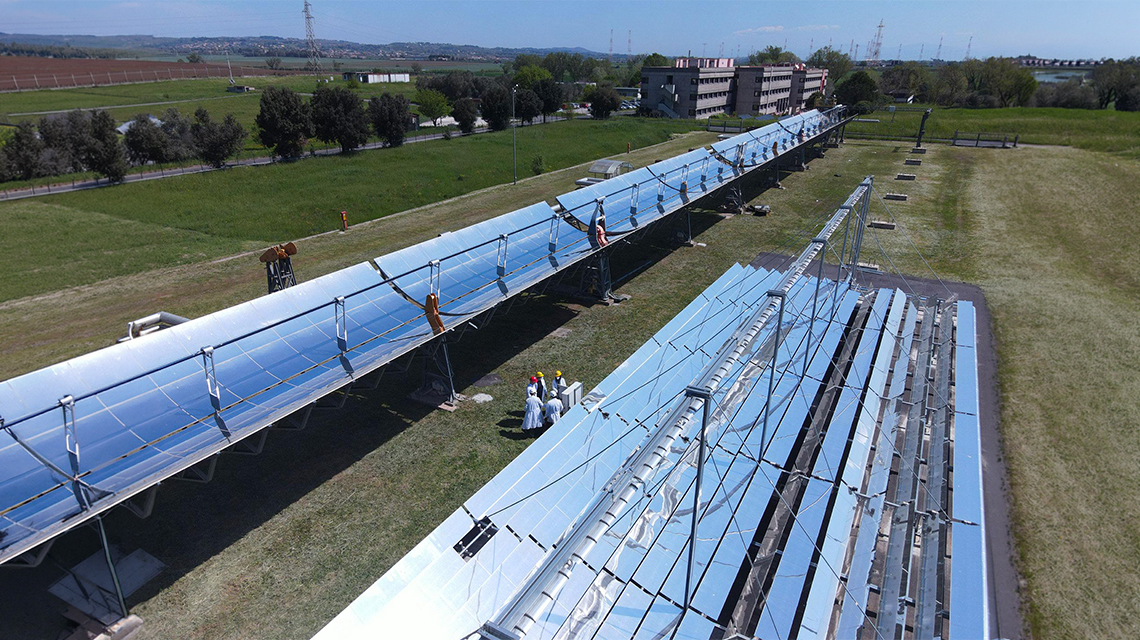
Energy: Molten salt thermal storage systems to increase storage capacity
Promoting the use of molten salt thermal storage systems as a solution to the growing demand for energy storage in Europe is the objective of the European SALTOpower [1] project, in which ENEA participated through the Energy and Thermal Storage Laboratory of the Department of Energy Technologies and Renewable Sources.
The demand for energy storage systems in Europe Is experiencing unprecedented growth due to an increase in the installation and use of intermittent and non-programmable renewable energy sources. Currently, the main solution is lithium-ion batteries, whose supply chain—being heavily concentrated in China—raises questions regarding industrial autonomy in Europe.
The research conducted by the SALTOpower project focused on the use and integration of molten salt systems in multifunctional energy hubs that combine electrical, thermal and chemical energy carriers.
“Mixtures of nitrate salts, commonly used as fertilizers, combine several properties - high stability, good thermal capacity, low vapor pressure and wide operating temperature ranges - which make them suitable for use as thermal fluids. These characteristics make them suitable for high-temperature applications, like the chemical industry, and they have become the industry standard in solar thermal power plants” said researcher Marco D’Auria, ENEA project lead.
The SALTOpower project is exploring the possibility of using molten salts as energy storage systems: by storing excess energy when production is high and releasing it when production is low or when demand peaks, molten salts ensure a stable and dispatchable energy supply, thereby contributing to the stability and resilience of the grid.
“Adopting molten salt technology—whether by integrating it or using it as an alternative to other energy storage solutions—would ensure independence in the supply of raw materials, given that it would rely on materials that are abundant in Europe, like steel and/or readily available like nitrate-based salts” said D’Auria.
Scalability[2] and modular design allow it to be used in remote or isolated locations to address energy access issues.
Estimates indicate that energy storage power capacity requirements to support grid flexibility at EU level will be between 200 and 400 GWh by 2030. By 2050, with full decarbonization, demand will rise to the order of TWh. Currently, with approximately 77 GWh of battery storage installed, Europe covers only a small fraction of its future needs.