Italian National Agency for New Technologies, Energy and Sustainable Economic Development

MEDIA - Press office ENEA
Energy: ENEA tests low-cost energy storage systems for electricity and heat
ENEA is developing a new compact system designed to store both electrical and thermal energy using low-cost, readily available materials for later reuse in industrial applications and electricity production.
The initial results of the experiment were published in the journal Energies and could pave the way for promising applications such as the storage of excess renewable electricity (energy overload, to ensure stability of the electricity grid), the supply of heat for industrial processes (in the 150-300 °C range), and residential/district heating.
"Our electro-thermal storage prototype is a hybrid system powered by both electricity, (like excess electricity produced by wind and photovoltaic power) and heat generated by renewable energy technologies and/or recovered from industrial processes, capable of storing thermal energy at temperatures of up to 350-400 °C " explained one of the authors of the study, Raffaele Liberatore, a researcher at the ENEA Energy and Thermal Storage Laboratory, of the Energy Technologies and Renewable Sources Department.
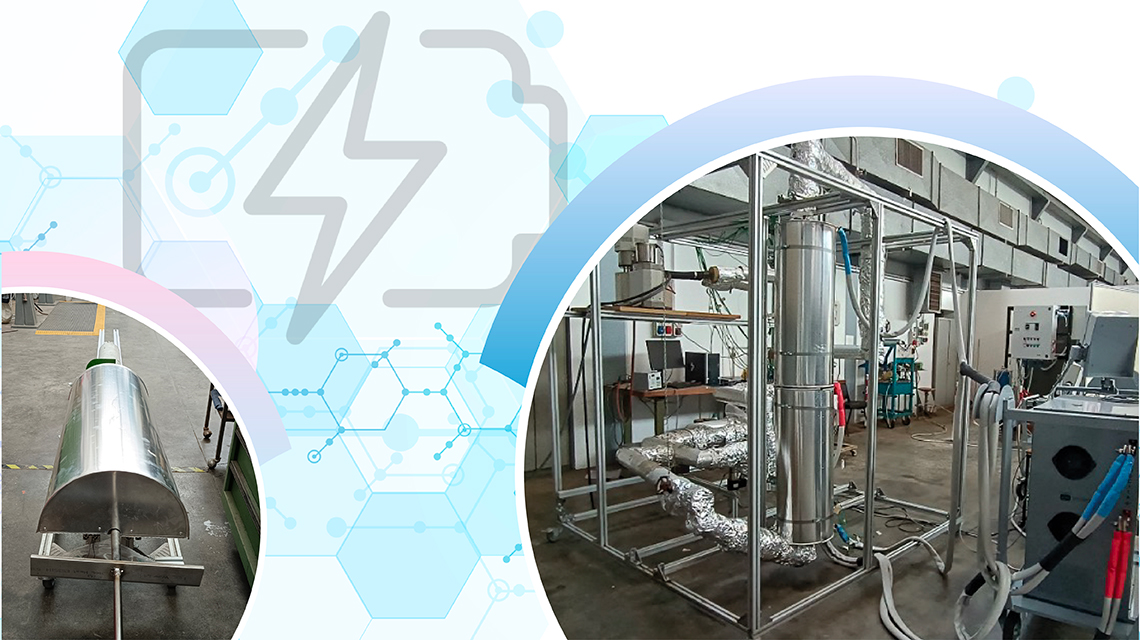
The ENEA thermal storage prototype consists of a newly designed concrete block with added metal and polymer fibers from industrial waste and solar salts, whose main purpose is to increase the stored energy density. A stainless steel tubeis located inside the system that acts as an electrical resistance: when electricity passes through it, it heats up quickly, generating heat (due to the Joule effect, the same principle used in electric heaters).
“An experimental comparison has shown that electric heating, in the current configuration of the device, is faster than thermal heating; moreover, cyclic charging and discharging tests have shown its perfect replicability” said Liberatore. “The electro-thermal storage system developed for laboratory testing is still small in size, but modules of larger size and capacity, even scalable ones, can be easily built” he concluded.
So far, research efforts have focused on identifying low-cost, non-toxic, and widely available materials to develop solutions that offer high flexibility in capacity and integration.
The storage module was installed at the ENEA ATES [4] (Advanced Thermal Energy Storage System) experimental plant to conduct thermal characterization with charging and discharging cycles similar to those expected in industrial plants.
The next activities will focus on the development and testing of larger modules to optimize their performance by reducing heat loss, also with a view to conducting a realistic assessment of their costs.
“The medium-high temperature (100-550°C) thermal storage systems developed by ENEA decouple the generation of heat and electricity from the immediate availability of solar resources using non-strategic materials” pointed out study co-author Michela Lanchi, head of the ENEA Energy and Thermal Storage Laboratory. “These storage systems” she concluded “can act as true energy hubs, capable of storing thermal and electrical energy generated from various renewable sources and making it available on demand, contributing to grid stability.”
Notes
[1] Steel mill slag, carbon fibers recovered from filters.
[2] Mixture of 60% sodium nitrate and 40% potassium nitrate by weight.
[3] Useful length 1.4 m and concrete diameter 0.12 m.
[4] This system uses a circuit through which special oil flows, capable of heating up to 350°C or cooling down, thanks to equipment that can supply up to 3 kW of heat or remove up to 15 kW of cold. The oil circulates at a maximum flow rate of 18 liters per minute. The system is equipped with four electrically controlled valves that allow the oil to circulate in different directions (clockwise, counterclockwise, or bypass), thus facilitating the charging phase (when heat is accumulated) or discharging phase (when heat is released) from the module.