Italian National Agency for New Technologies, Energy and Sustainable Economic Development

MEDIA - Press office ENEA
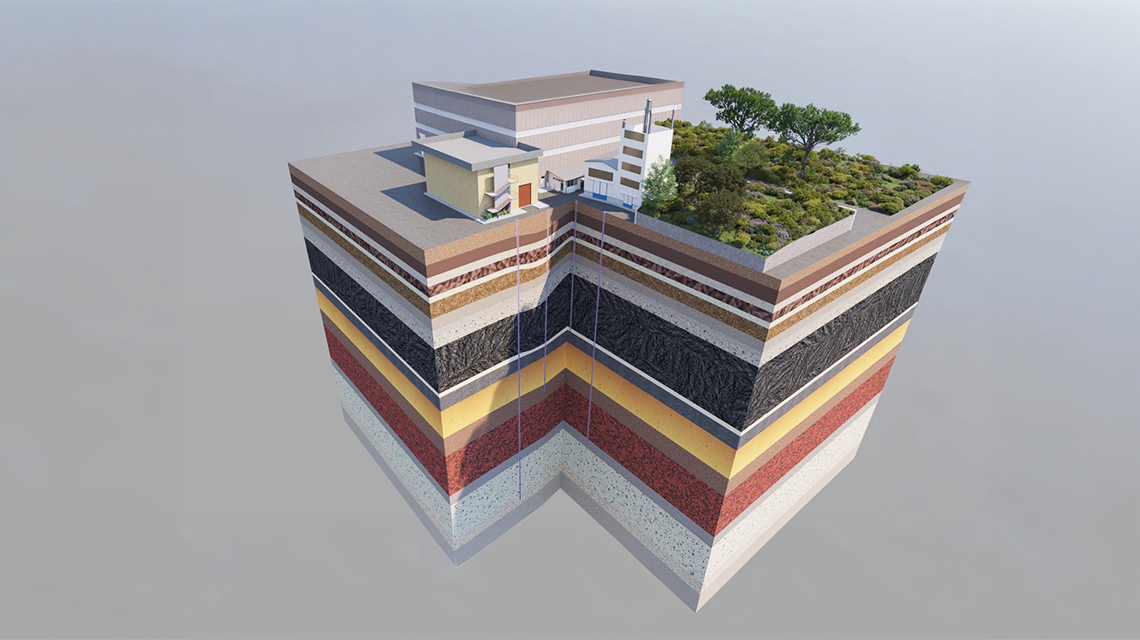
Energy: ENEA develops an innovative geothermal system for building heating and cooling
ENEA has developed an innovative geothermal system for the sustainable heating and cooling of buildings at its Casaccia Research Centre in Rome. Developed within the framework of the Research Programme on the Italian Electricity System, promoted by the Italian Ministry of the Environment and Energy Security, the system combines the use of subsurface heat with a latest-generation heat pump capable of exploiting both ambient air and the ground as thermal sources.
The heat naturally present in the subsurface at relatively low temperatures [1] (below 90°C) is harnessed through four boreholes drilled to different depths [2] and equipped with geothermal probes [3] and fibre-optic sensors [4].
“Unlike other renewable energy sources, whose availability depends on variable weather conditions, geothermal energy provides a continuous and reliable supply, making it particularly well suited to ensuring stable energy provision,” explains Anna Carmela Violante, a researcher at ENEA’s Department of Energy Technologies and Renewable Energy Sources (TERIN). “Furthermore, geothermal technologies can help reduce dependence on energy and material imports, as they do not require critical or strategic raw materials, while also making the energy system more resilient to cost fluctuations caused by geopolitical crises,” Violante adds.
“During periods of heating or cooling demand, the thermal stability of the heat source or heat sink is essential for ensuring high heat-pump efficiency,” states Raniero Trinchieri, a researcher at ENEA-TERIN.
Italy has a century-long tradition in the exploitation of geothermal resources and currently ranks eighth worldwide in terms of installed geothermal power-generation capacity, with approximately 916 MW and an annual electricity output of around 5.7 TWh, predominantly concentrated in Tuscany [5]. About the direct use of geothermal heat, Italy is among the leading European countries, with an estimated installed capacity of approximately 1,316 MWth, used primarily for space heating, spa and agricultural applications, and low-enthalpy geothermal systems [6].
“Despite these achievements, the growth of Italy’s geothermal sector has remained substantially stagnant over the past decade, highlighting a potential that is still largely underexploited,” emphasises Simona De Iuliis, Head of the Strategic Support Section at ENEA-TERIN. “Geothermal energy is widely regarded as a ‘sleeping giant’, particularly in Italy, which has the greatest geothermal potential in continental Europe. Exploiting just 2% of this potential within the first five kilometres of the Earth’s crust could enable geothermal energy to provide up to 10% of the electricity production projected for 2050 and approximately 25% of final thermal energy consumption [7],” she adds.
More broadly, the geothermal resources available in Italy could theoretically meet more than four times the country’s total energy demand for electricity and heat—equivalent to 120 million tonnes of oil equivalent in 2022—while enabling a reduction of approximately 40% in natural-gas consumption [8].
“To unlock this potential, it is necessary to overcome the technical and financial challenges that continue to limit the large-scale deployment of geothermal technologies and to develop targeted energy policies,” states Giulia Monteleone, Director of ENEA-TERIN. “In addition to introducing incentive mechanisms, including measures aimed at mitigating technological risks, we advocate the simplification of permitting procedures, the systematic mapping of geothermal potential and the identification of suitable areas, so that geothermal energy can become a driver of economic growth and a central component of the transition towards a sustainable energy future.”
The next stage of ENEA’s research activities will involve the development of an experimental hybrid system combining a low-enthalpy geothermal source with solar thermal energy. The objective is to investigate subsurface thermal energy storage in impermeable soils, primarily clay-rich formations, at depths exceeding 100 metres.
Foto e video


Note
[3] Geothermal probes configured with a double-U design.
[4] DTS (Distributed Temperature Sensing) technology sensors.
[5] EGEC, 2025. Geothermal Market Report 2024. European Geothermal Energy Council, Brussels
[6] Macut M. et al., (2025) Findability of geothermal energy websites in seven EU countries and Iceland. Geothermics.
[7] TEHA Group S.p.A. e The European House – Ambrosetti S.p.A - Energy Landscape
[8] TEHA Group S.p.A. e The European House – Ambrosetti S.p.A - Energy Landscape