Italian National Agency for New Technologies, Energy and Sustainable Economic Development

MEDIA - Press office ENEA
Environment: ICESP report, over 250 best practices in the circular economy
Annual conference of the ICESP platform, “Best practices” awarded
According to the report presented in Rome at the eighth annual ICESP Conference, there are 253 circular economy best practices recorded in the database of the Italian Circular Economy Platform (ICESP), 245 of which implemented within Italy. The conference was attended by ENEA President Francesca Mariotti and Director of the Sustainability Department Claudia Brunori. Also speaking were Roberto Morabito, President of CETMA and the ICESP Platform, as well as representatives from the ECESP Platform, MIMIT, MASE, the Metropolitan City of Rome Capital, ERION, CONAI, the Kyoto Club, the Ecosistemi Foundation, the Article 49 Foundation, Symbola and the Sustainable Development Foundation.
The ICESP Report provides an up-to-date overview of circular economy best practices that are contributing to the transition toward a circular economy in Italy; These primarily concern the agri-food, textile and construction sectors, with a majority of initiatives in the production (66 mapped best practices) and waste management (60) phases, where circular strategies can generate the greatest benefits in terms of resource efficiency and reduced environmental impacts. These are followed by the supply of secondary raw materials (55), innovation (45) and consumption (27). The main promoters of these best practices are businesses, followed by public entities and associations, while at the regional level, Lombardy, Lazio and Emilia-Romagna are particularly active.
“ENEA plays a leading role in the development of the ICESP platform, the national hub of the European Platform for the Circular Economy, with an active presence across all its thematic areas and in the main national and European institutional forums on the circular economy, ecodesign and critical raw materials, as well as in strategic forums and initiatives supporting sustainability policies” pointed out ENEA President Francesca Mariotti. “The participation figures and the quality of the results achieved,” she said “demonstrate the soundness of the path we have taken and confirm ENEA leading role in promoting circular economy models and solutions, partly thanks to initiatives like the Italian Phosphorus Platform and intensive technology transfer activities, particularly toward SMEs.”
“Best practices are key to understand how the principles of the circular economy can be translated into concrete solutions across various industrial sectors and regions, contributing to reduced environmental impacts, more efficient use of resources and development of more sustainable economic models” said Roberto Morabito, president of the CETMA and ICESP Platform. “The report” he said “analyses the distribution of practices by economic sector, product life cycle stage, type of organization and geographic area, providing a snapshot of the dynamics at play in Italy’s circular transition. At the same time, it helps identify replicable models and serves as a useful tool for strengthening dialogue among institutions, businesses, research and civil society”.
The ICESP report devotes specific attention to the role of circular biotechnology, analysing 74 best practices—accounting for approximately 30% of the total—that utilize biotechnological solutions for biomass valorization, resource recovery and the development of new bio-based materials and products. Biotechnology practices are primarily promoted by private companies, particularly in the agri-food, bioeconomy, and waste management sectors, often in collaboration with public entities and research centers. They are concentrated mainly in Lombardy, Piedmont and Lazio.
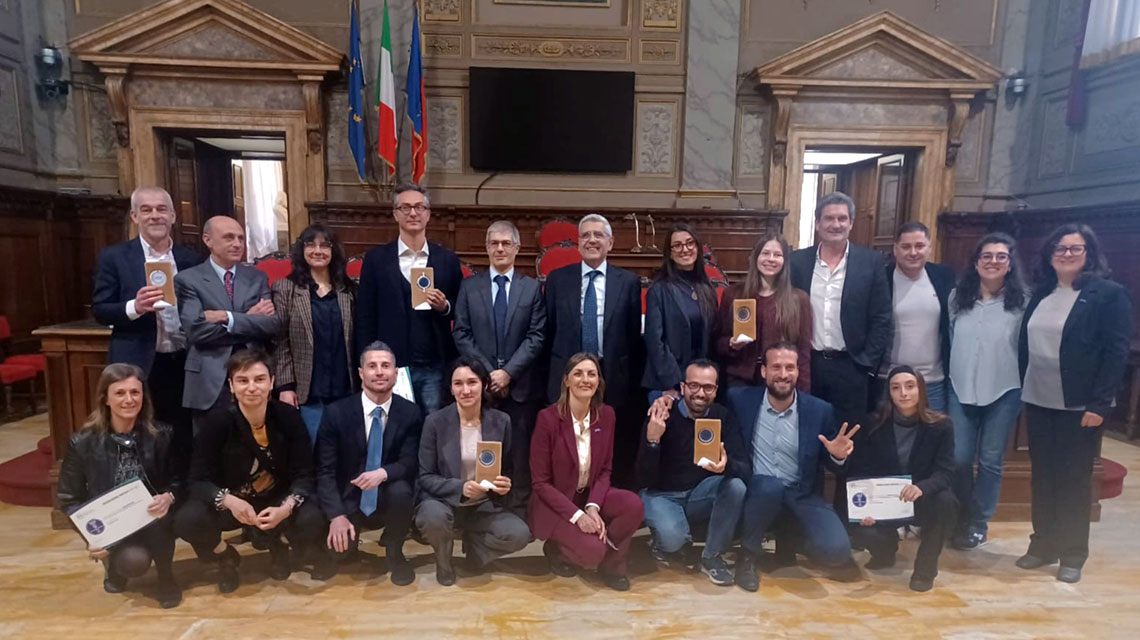
To highlight and promote the dissemination of ICESP best practices, thereby encouraging their replication, the “ICESP Best Practices Award” was established this year. “For this first edition, we received 51 nominations from companies and public administrations, all characterized by a high level of quality, innovation and potential for replication” emphasized Claudia Brunori, director of the ENEA Sustainability Department and ICESP vice president. “This is an important sign,” she said “that attests to the vitality and spread of circular economy initiatives within the Italian production system and across the country”.
In the “resource efficiency and impact reduction” category, the Prato-based company Corertex was recognized for its ability to recover up to 96% of textile materials, averaging over 100,000 tons annually. In the “eco-design and product and service innovation” category, the Milan-based company Movopack stood out with a packaging system reusable up to twenty times, designed for e-commerce, retail and B2B brands.
In the “Education, Training and Cultural Change” category, the Emilia-Romagna Region won with a structured and accessible training program that strengthens the capacity of public entities and economic operators to apply the Minimum Environmental Criteria, promoting sustainable procurement practices.
In the “Communication of Circularity and Transparency” category, the Marche-based company Matrec was awarded for its software that enables the measurement and monitoring of the circularity of materials, products and services.
In the category of “social innovation, inclusion and community impact” the award went to the Let’s Do It! Italy network, which developed an innovative regional model in the province of Naples that integrates environmental education, active citizenship and the circular economy, contributing to waste reduction and the improvement of public spaces.
Finally, in the category “territorial regeneration, nature and local systems” the Apulian company Tondo was honored for its platform, which connected numerous entities active in the circular economy in the province of Taranto and accelerated nine startups and innovative projects.
Special mentions were awarded to the company Rinnovative for recycling a widely used wood-based material; to the Reuse Market, a space dedicated to giving objects a new life, reducing waste and emissions; to the reuse centers of the Emilia-Romagna Region, a network that transforms reuse into tangible value for the environment and communities; and to the advanced and integrated molecular diagnostics for health and environmental prevention developed by the A.I.D.A. spin-off of the University of Catania.
Finally, the special mention in “Communication of Circularity and Transparency,” with the award conferred by EconomiaCircolare.com, was assigned to the best practice “European Week for Waste Reduction,” coordinated in Italy by the International Association for Environmental Communication (AICA).
The ICESP Platform, which works in close collaboration with the European Commission’s ECESP (European Circular Economy Stakeholder Platform), represents the most structured and extensive community of Italian circular economy stakeholders, bringing together over 400 experts from more than 200 organizations, including local and national public institutions, businesses, trade associations, the research community and civil society.