Italian National Agency for New Technologies, Energy and Sustainable Economic Development

MEDIA - Press office ENEA
Energy: ENEA studies safety of fast modular reactors
Small-scale sodium-cooled fast modular reactors characterized by greater safety, sustainability, and economic efficiency are at the forefront of next-generation nuclear power, which the European ESFR-SIMPLE[1] project aims to integrate into the European energy system. ENEA is participating in the project, focusing on safety and optimization of nuclear fuel.
To make this type of reactor simpler and more economical, the focus is on shrinking its physical dimensions (from 3,600 to 360 MWt). Another aspect being addressed is monitoring and processing operational data using artificial intelligence, along with the experimental testing of new components like thermoelectric pumps and expansion joints.
“ENEA has always supported research on fast reactors, starting with the Unified Nuclear Project (PUN), which led to the start of construction of the Fuel Element Test Reactor (PEC) at the Brasimone Research Center (Bologna), which was then halted after the 1987 referendum, up to liquid-lead-cooled reactors” pointed out Massimiliano Polidori, head of the Laboratory for Nuclear Plant Safety.
In 2001, an international cooperation initiative for the research and development of fourth-generation nuclear energy systems, the GEN-IV International Forum, included sodium-cooled reactors on the list of potentially more sustainable technologies. “This decision has reignited international interest in this sector and prompted us to participate in various European initiatives to strengthen and improve our design and analysis capabilities regarding fast liquid-metal reactors—a necessary step toward closing the fuel cycle and ensuring nuclear sustainability” said Polidori. “For instance” he continued “we participated in the CP-ESFR project for the construction of a sodium-cooled fast reactor and in ESFR-SMART to improve its safety. The ESFR-SIMPLE project represents a further step in Europe’s path toward the development of advanced nuclear reactors.”
But how do sodium-cooled Small Modular Reactors (SMRs) work? These low-power, modular nuclear reactors use liquid sodium as a coolant. Thanks to its high thermal conductivity, sodium allows for effective heat removal even at low pressure and enables the use of passive safety systems—that is, devices that ensure the reactor’s cooling and stability by leveraging natural physical laws like gravity and convection, without the need for human intervention or electrical power, increasing the plant’s safety margins.
ENEA research is focused on safety, specifically on the ability to remove residual heat in high-power-density systems, both during normal operation and in the event of an accident. through advanced simulations, researchers are studying how nuclear fuel might react under abnormal conditions. “These studies allow us to compare different design solutions and identify the most robust configurations for safety and reliability. Preliminary results show how passive safety systems can reduce the risks associated with the most severe accident scenarios in fast liquid-metal reactors” concluded Polidori.
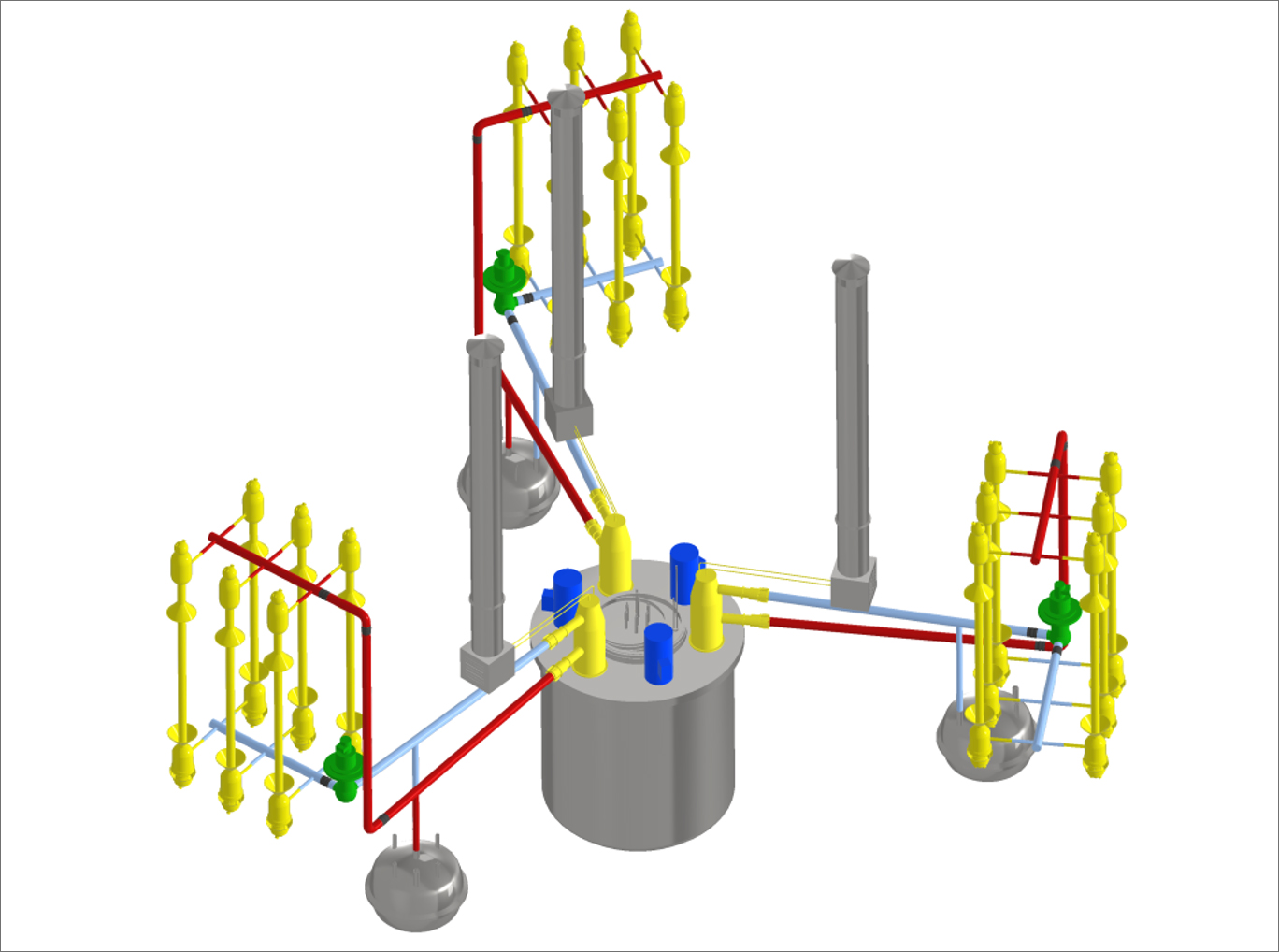
Simplified diagram of the SMR sodium-cooled reactor