Italian National Agency for New Technologies, Energy and Sustainable Economic Development

MEDIA - Press office ENEA
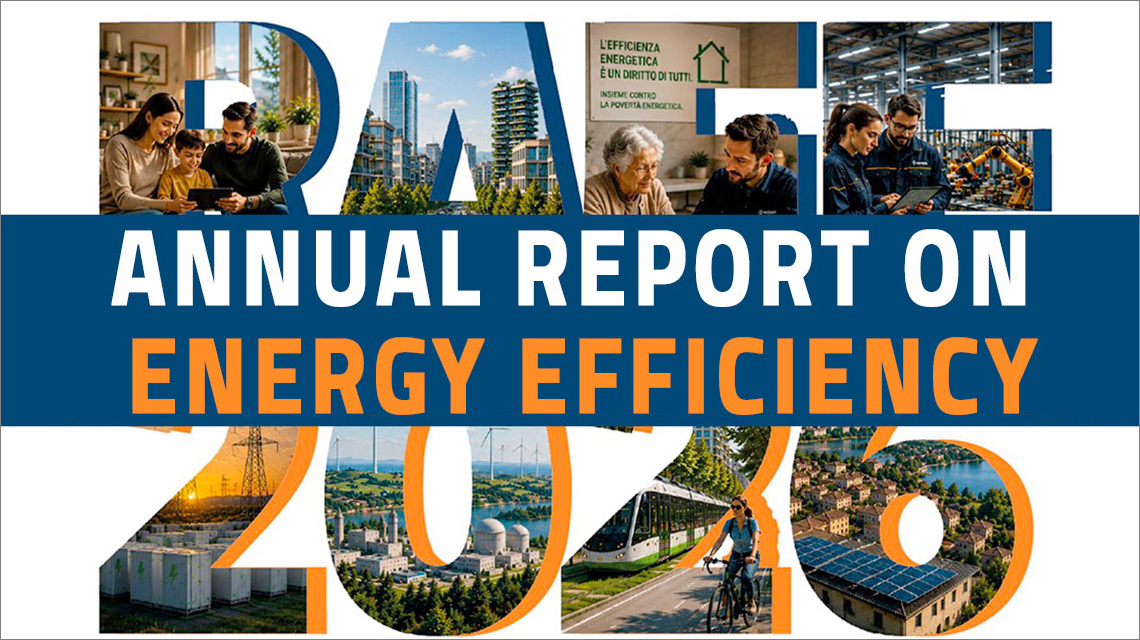
Energy: ENEA Report on efficiency, Italy saves 5.1 Mtoe
Savings comparable to the annual electricity consumption of Emilia-Romagna and Veneto
In Italy, between 2021 and 2025, energy savings achieved through monitored efficiency measures totaled 5.08 Mtoe, equivalent to over the annual electricity consumption of two industrial regions like Emilia-Romagna and Veneto. This figure represents 85% of the intermediate goal of the Integrated National Energy and Climate Plan (PNIEC), set at 6 Mtoe.
These findings are reported in the ENEA 15th Annual Report on Energy Efficiency, presented in Rome during a conference attended by ENEA representatives, including President Francesca Mariotti and Ilaria Bertini, Director of the Energy Efficiency Department.
A key factor contributing to this result was the use of tax credit mechanisms, which generated energy savings of 2.67 Mtoe during the 2021–2025 period, reaffirming their role as the primary driver (approximately 52% of total savings). However, in 2025 alone, a reduction was observed (0.24 Mtoe, -37% compared to 2024), in line with the scaling back of incentives.
Energy savings generated through White Certificates declined, resulting in a reduction in consumption of approximately 0.115 Mtoe in 2025 (-4.5% compared to 2024), with a cumulative total for 2021–2025 of 0.83 Mtoe, in line with the PNIEC’s intermediate estimates.
In contrast, savings incentivized through the Conto Termico increased, amounting to 0.131 Mtoe in 2025 alone (for a cumulative total of 0.476 Mtoe), while sustainable mobility measures showed a slight decline (0.404 Mtoe, -6% compared to 2024), although they remained among the most significant contributors. Savings resulting from projects financed through cohesion funds remained essentially stable, amounting to approximately 0.022 Mtoe in 2025, in line with the 2024 figure.
“The data and analyses contained in the Report confirm that the value of energy efficiency goes beyond reducing consumption, because it generates economic, environmental and social benefits that reinforce one another” pointed out ENEA President Francesca Mariotti. “Energy efficiency helps improve competitiveness, sustainability and quality of life in every sector — from businesses to public administration to households” she said. It is precisely this ability to produce widespread effects that makes it one of the most effective tools today for strengthening the economic system and supporting sustainable growth, in a complex and rapidly evolving international context.”
Furthermore, the report highlights how the conclusion of the expansion phase of the SuperEcobonus has significantly reduced the measure’s contribution (0.113 Mtoe in 2025), despite substantial cumulative benefits (1.47 Mtoe). At the same time, other tax credits are also slowing down: in 2025, the Home Bonus returned to more modest levels (0.057 Mtoe), after the growth recorded in 2024 (+35% compared to 2023), while the Ecobonus shows an even more pronounced reduction, with savings falling from 0.161 Mtoe in 2024 to 0.072 Mtoe in 2025.
Despite this year-over-year reduction, both measures continue to play an important role in the medium term: in fact, cumulative energy savings over the five-year period 2021–2025 amounted to 0.791 Mtoe for the Ecobonus and 0.375 Mtoe for the Home Bonus, confirming the contribution of these standard measures to the improvement of the energy efficiency of the building stock.
As for of end-use energy efficiency, 2025 marks a midpoint in the new cycle of mandatory energy audits. As of December 2025, 671 audits from 438 obligated entities had been uploaded to the
Dedicated ENEA Portal, down from 2024 (-20%) but in line with the cyclical pattern of the mechanism. The measures implemented generated savings of approximately 29.7 ktep/year of primary energy (an average of 0.10 ktep per measure), while the total measures identified represent a potential savings of 68.2 ktep/year of primary energy.
“The findings presented in the report show the central importance of an integrated approach combining technological innovation with cultural transformation, promoting a more informed, efficient and sustainable use of energy across all sectors” pointed out Ilaria Bertini, Director of the ENEA Energy Efficiency Department. “In this context” she continued “ENEA is called upon to play a leading role, providing institutions, businesses and citizens with advanced tools, specialized expertise and technical-scientific support, in order to contribute to the achievement of national goals for decarbonization, energy security and competitiveness”.
For the full report and the executive summary: pubblicazioni.enea.it
ENEA video statements (President Francesca Mariotti, Director of the Energy Efficiency Department Ilaria Bertini and Head of the Energy Efficiency Policy Monitoring Laboratory Alessandro Fiorini):