Italian National Agency for New Technologies, Energy and Sustainable Economic Development

MEDIA - Press office ENEA
Energy: ENEA-Assovetro, how to decarbonize energy-intensive industries like glassmaking
An ENEA-Assovetro study published in the international journal Gases proposes seven technological solutions for decarbonizing Italy's glass industry, tailored to the Italian context and aligned with the goal of climate neutrality by 2050.
“This study analyses the decarbonization of the glass industry, an energy-intensive sector, through an integrated approach designed to align with specific national circumstances” said Assovetro President Marco Ravasi.
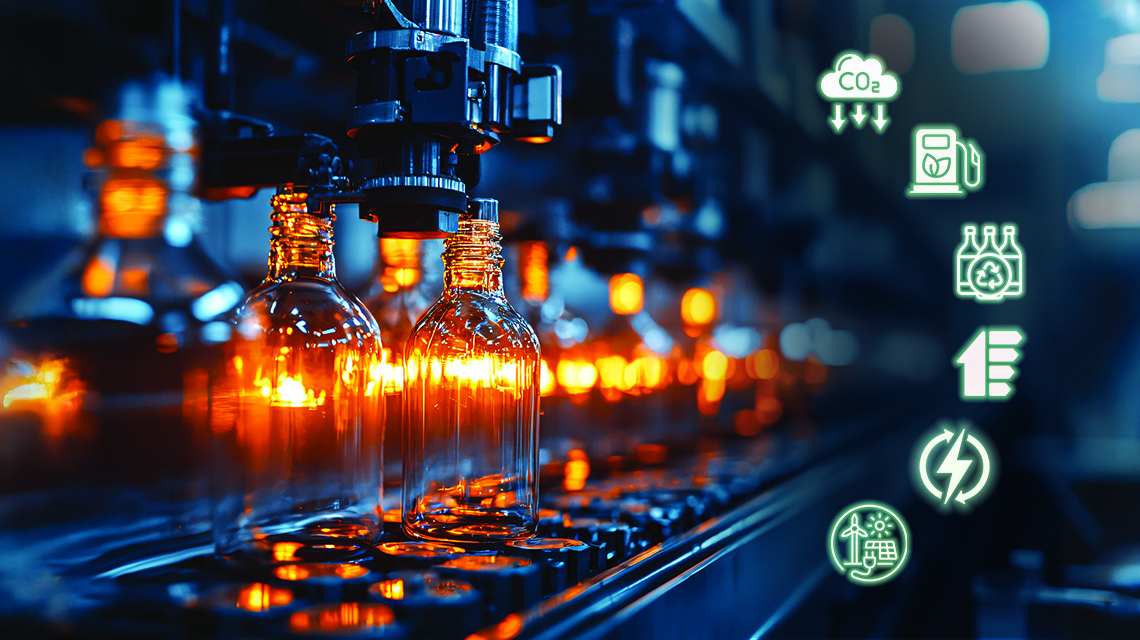
The seven solutions identified to decarbonize the energy-intensive glass sector include the use of green fuels (biogas and hydrogen); CO₂ capture and storage; energy efficiency measures; electrification of furnaces; increased use of recycled glass; use of already decarbonized raw materials; use of electricity from renewable sources.
“These technological levers are designed to combine flexibly, adapting to the specific circumstances of plants and types of production, bearing in mind that diversification of solutions is the underlying condition for achieving climate neutrality objectives” pointed out the study's co-author Claudia Bassano, a researcher at the ENEA Energy Technologies and Renewable Sources Department (TERIN).
The analysis highlights the urgent need for concrete action to accelerate the spread of low-carbon technologies across the sector. Relying solely on reducing indirect emissions (those linked to plant operation thanks to greater use of electricity from green sources) forecast for 2050 is insufficient to meet Paris Agreement targets.
Glass decarbonization will not come from a single technological breakthrough but it requires an integrated approach capable of reducing emissions and energy consumption customized to fitting in with italian circumstances.
The researchers applied the different solutions to two different decarbonization strategies, both of which in the simulation would allow the glass industry to achieve the goal of climate neutrality by 2050; the differences between the two scenarios are significant.
The first strategy, called Green Fuel, showed the adoption of biomethane and green hydrogen to be the most effective measure among all those adopted, allowing a 45% reduction in carbon dioxide emissions. followed by CO2 capture and storage measures, which would contribute to a 26% reduction in residual emissions (followed by 21% from energy efficiency and electrification, 3% from the use of glass scrap, and 4% from decarbonized alternative raw materials).
In the case of the strategy known as Carbon Capture and Storage (CCS), the real driver of the transition was precisely the capture and storage of CO2, which eliminated 69% of emissions; followed by 21% from energy efficiency and electrification, 7% from green fuel, and 3% from recycled glass.
“We have calculated that the total cost of adopting the Green Fuel strategy by 2050 will be around €15 billion, divided into €4 billion for plants and infrastructure and €10.6 billion for operating costs” said Claudia Bassano of ENEA-TERIN. " Critical elements of this strategy compared to CCS,“ she went on ”are the high costs of green hydrogen and biofuels and their limited availability, which would limit its immediate availability in energy intensive industries like glass manufacturing.
In addition, there are also significant infrastructure challenges: biogas is compatible with existing furnaces while hydrogen may require modifications if employed in high percentages."
As regards the CCS strategy, the total costs amount to €11.2 billion, divided into €5.4 billion for plants and infrastructure and €5.8 billion for operating costs. “Despite the lower cost of this scenario, CCS technologies still struggle with finding suitable geological sites, the complexity and high cost of CO2 separation and regulatory and authorization obstacles that can significantly complicate implementation,” concluded Bassano.
"The transition to climate neutrality of the Italian glass industry, as well as many other energy-intensive sectors, is technically feasible but requires structured and long-term collaboration between industry, the research community and public administration to ensure the development and adoption of enabling technologies, adequate financial support and bureaucratic and regulatory simplification," pointed out Giulia Monteleone, director of ENEA-TERIN.
The glass sector in Italy emits around 3.7 million tons of CO₂ annualy, 75% of which is generated on site via combustion of natural gas in furnaces and chemical reactions of raw materials during mixing) and the rest from electricity consumption in production plants.