Italian National Agency for New Technologies, Energy and Sustainable Economic Development

MEDIA - Press office ENEA
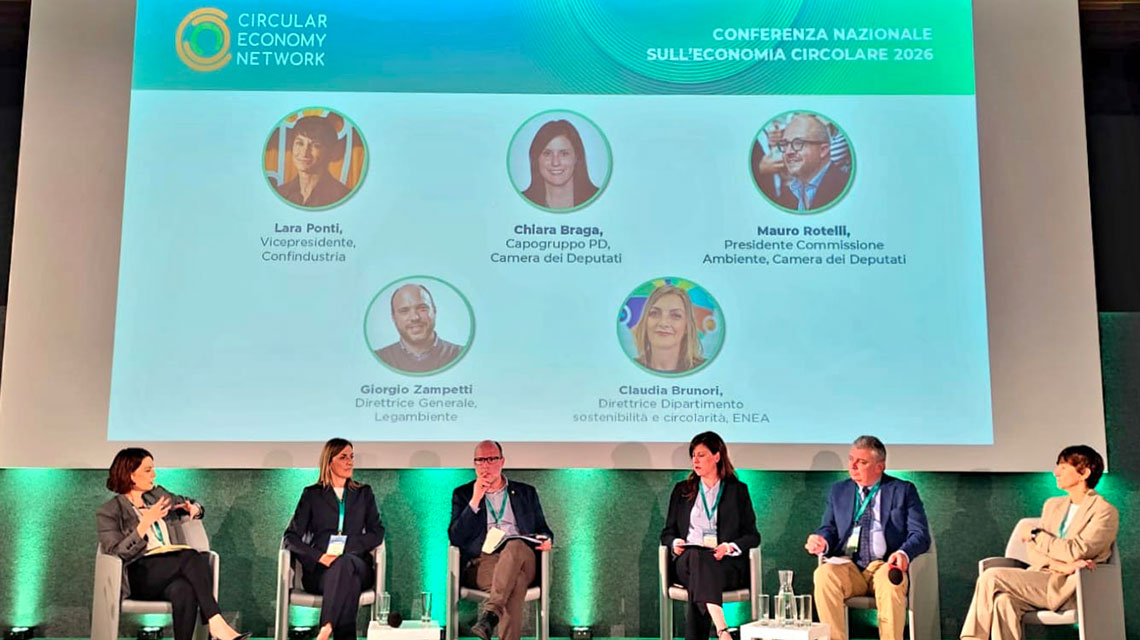
Circular Economy: Italy leads Europe, but remains too dependent on material imports
Eighth Circular Economy Network Report at the 2026 National Conference on the Circular Economy: it’s not just the crisis in the Strait of Hormuz, tensions with Russia, and U.S. tariffs, but a decade-long trend among nations to impose restrictions on exports of critical raw materials. Market and global economic constraints that make accelerating the energy and circular transition urgent and necessary.
Italy is a leader in Europe for circularity but remains the country most dependent on material imports among the major EU economies. 46.6% of processed raw materials come from abroad, compared to an EU average of 22.4%, with Spain at 39.8%, Germany at 39.5% and France at 30.8%. The cost of this dependence is becoming increasingly unsustainable. In 2025, spending on material imports reached nearly 600 billion euro, a 23.3% increase compared to 2021, despite a decline in overall volumes. The cost of metals—nickel, copper, steel—rose by 18% and accounts for 40% of the total value of national imports. This economic pressure is set to increase as geopolitical tensions persist and prices and volatility in the supply of strategic raw materials, as well as fossil fuel energy sources, continue to rise.
The data revealed in the 8th Report on the Circular Economy in Italy 2026, presented in Rome during the National Conference on the Circular Economy—organized by the Circular Economy Network in collaboration with the Foundation for Sustainable Development and ENEA—thus highlight both the strengths and weaknesses of our country and Europe. Italy has a good level of circularity in terms of waste recycling rates and efficient use of materials, but it invests little in circular innovation, has weaknesses in various secondary raw materials markets and remains heavily dependent on imports of strategic raw materials.
On the other hand, Europe has committed to promoting circularity through a series of measures, achieving positive but still insufficient results, especially in the new international context. In fact, it maintains a very low rate of circular material use, around 12%, and is vulnerable because it relies heavily on imports of numerous critical raw materials, including those strategic for the security and sustainability of its development. For this reason, it is preparing a new framework law, the Circular Economy Act, scheduled for the end of the year, which should help accelerate the circularity of the European economy.
The recent OECD report *Inventory of Export Restrictions on Critical Raw Materials 2026* highlights a well-established trend, from 2009 to 2024, of restrictions on global trade, rising nationalism and protectionism, as evidenced by a fivefold increase in restrictions (tariffs, quantitative limits, and bans) on the export of critical raw materials: restrictions affecting materials now essential for development like lithium, cobalt, nickel, graphite, rare earths and manganese. This is an ongoing trend that predates the crisis in the Strait of Hormuz, which has further exacerbated it and made it more evident.
For these reasons, at the heart of this year’s National Conference on the Circular Economy is a reflection on the greater circularity of the economy—not merely as a choice for sustainability but as a necessity for security and competitiveness.
“With the Hormuz crisis, there is much discussion about the need to reduce the vulnerability caused by dependence on fossil fuel imports, but too little about the equally critical vulnerability linked to numerous raw materials, crucial for security of supply and subject to high price volatility”, said Edo Ronchi, President of the Foundation for Sustainable Development.
"Greater circularity in the economy—which entails more efficient use of materials, reduced consumption of raw materials through waste recycling, and greater reliance on repair, reuse and sharing, along with more frugal and responsible consumption patterns—will increasingly become a necessity dictated not only by the climate crisis and resource constraints, but also by the geopolitical context. Circularity is now an essential component of an industrial policy that is in step with the times”.
Europe is not moving fast enough: the 2030 target is at risk
On the European front, the Report highlights a significant lag: despite a notable increase in recycling and a reduction in disposal, overall waste generation remains high and consumption of raw materials—largely imported—remains substantial. Global volumes of materials used have more than tripled over the past 50 years and continue to grow at a rate of 2.3% annually. At this pace, the EU will not reach its target of a 24% circularity rate by 2030. Yet the tools are available: in 2025 and 2026, the EU adopted the revision of the Waste Framework Directive, the Packaging Regulation, the ESPR Ecodesign Plan 2025–2030—with the introduction of the digital product passport—and the Right to Repair Directive.
It is therefore up to Europe to turn the linear economy into a circular model capable of reducing waste, dependence on virgin raw materials and environmental impact. In view of the future Circular Economy Act, the Circular Economy Network proposes ten concrete actions to accelerate this transition: creating a single market for secondary raw materials; strengthening the recovery of electronic waste and critical materials; designing more durable, repairable and recyclable products; extending producers' responsibility to all supply chains; introducing tax incentives for repair, reuse and refurbishment; using public procurement to support circular markets; promoting industrial alliances between production and recycling; strengthening the role of cities and regions in the transition; mobilizing public and private investments for the circular economy; promoting common standards and international cooperation for competitive and sustainable circular supply chains.
Phosphorus, magnesium, water: the new frontier of circularity as security. The section edited by ENEA
An innovative section of the 2026 Report, developed by ENEA, directly links circularity with safety of critical raw materials, a topic dramatically heightened by the Hormuz crisis. The Critical Raw Materials Act, which came into force in May 2024, sets specific targets: by 2030, 10% of critical raw materials must be extracted in Europe, 40% processed on the continent, and 25% obtained through recycling. Phosphorus, an essential component of fertilizers and animal feed, is a case in point: Europe's import dependency is 82%. The EU's main suppliers are Morocco (27%), Russia (24%), Algeria (10%), and Israel (7%): four countries with which geopolitical relations are anything but easy. The Report identifies sewage sludge as an underutilized source of recovery of this strategic element.
The dependence on foreign sources for magnesium is even more critical: China controls 88% of global production and the EU is totally dependent on primary magnesium. The Report analyses the potential of circular desalination: the brine produced by plants—traditionally considered problematic waste—contains elements like magnesium, potassium, calcium and bromine, with a theoretical market value of over €200 per cubic meter.
As regards water, approximately 30% of Europe's territory experiences seasonal water scarcity each year, with peaks exceeding 70% in southern Europe during the summer months. The European Commission's Water Resilience Strategy aims to reduce water consumption by 10% by 2030. For Italy, adapting large wastewater treatment plants to the new standards will require an estimated investment of between €800 million.
"The current geopolitical crisis has highlighted the vulnerability of our production system, which relies on imported raw materials for 46.6% of its resources" pointed out Claudia Brunori, head of the ENEA Sustainability Department. Although our country has developed a significant capacity for recycling and raw materials productivity, a paradigm shift is more necessary than ever, focusing on exploiting our urban 'mines' and efficiently using resources along the value chain, starting from the design and production phases. In this context, ENEA is strongly committed to the development and transfer of advanced technological solutions that can significantly accelerate the path towards circularity; however, to generate a systemic and lasting impact, appropriate regulatory and financial instruments are needed.
Circularity as a strategic response: the data that matters
In Italy, the circular material use rate (CMU) reached 21.6% in 2024—the highest in Europe—compared to an EU average of 12.2%. This means that over a fifth of the materials consumed in Italy are neither extracted nor imported, but recovered. This represents a huge strategic saving in terms of costs, emissions and geopolitical dependence.
The recycling rate for total waste managed (municipal and special) shows that Italy recycles 85.6% (137 Mt) of 160 Mt, more than double the EU average of 41.2% and significantly outperforming Spain (54.7%), France (52.3%), and Germany itself (44.4%).
Resource productivity has grown by 32% since 2019: in 2024, Italy confirmed its leadership, generating €4.7 in GDP for every kilogram of resources consumed, the highest value among major European economies and significantly above the EU average (€3/kg).
In terms of packaging recycling, Italy leads the European rankings with 76.7% in 2024 (CONAI data), compared to an EU average of 67.5%.
Every step forward in circularity directly means less imported oil, fewer metals purchased abroad and less exposure to geopolitical instability.
The investment issue: slowing down just when momentum is required
Finally, the Report highlights a worrying contradiction: just as the geopolitical context makes it urgent to accelerate circularity, private investment in Italy in typical circular economy activities (recycling, reuse, repair, rental, leasing) fell from €13.1 billion in 2019 to €10.2 billion in 2023 (from 0.7% to 0.5% of GDP). This negative trend is shared almost throughout Europe.
Regarding the PNRR, with over 1,100 projects funded for waste management facilities and recycling chains, spending remains low—around 17% as of October 2025—with deadlines in 2026 increasingly at risk. On the industrial level, the Transition 5.0 program has shown, according to the Report, "severe limitations in coherence and effectiveness" highlighting the need to permanently integrate circularity into national industrial strategies.
Employment in a series of typical activities more directly related to the circular economy accounts for 508,000 workers (2% of the total, in line with the EU average), but a 7% decrease compared to 2019. This signals that the Italian circular economy, despite excellent environmental performance, has not yet found a model for robust economic growth.
THE REPORT IN NUMBERS
65.0 - Italy's circularity index: second in the EU
21.6% - Circular material use rate: first in Europe (EU average 12.2%)
85.6% - Recycled waste out of total waste managed (EU average 41.2%)
€4.7/kg - Resource productivity: first among major EU economies (EU average €3/kg)
46.6% - Italian dependence on material imports: the highest among major EU economies (EU average 22.4%)
~€600 billion - Import costs in 2025: +23.3% from 2021 despite declining volumes
82% - EU dependence on phosphate rock imports (100% for elemental phosphorus)
88% - China's share of global magnesium production (EU dependence: total)
The 2026 National Conference on the Circular Economy is organized by the Circular Economy Network—an initiative promoted by the Foundation for Sustainable Development—in collaboration with ENEA (National Agency for New Technologies, Energy and Sustainable Economic Development), under the patronage of the European Commission, the Ministry of the Environment and Energy Security and the Ministry of Business and Made in Italy. The annual event brings together businesses, institutions and organizations committed to the transition to a more circular economy