Italian National Agency for New Technologies, Energy and Sustainable Economic Development

MEDIA - Press office ENEA
Agroindustry: Hi-tech system for producing quality food indoors
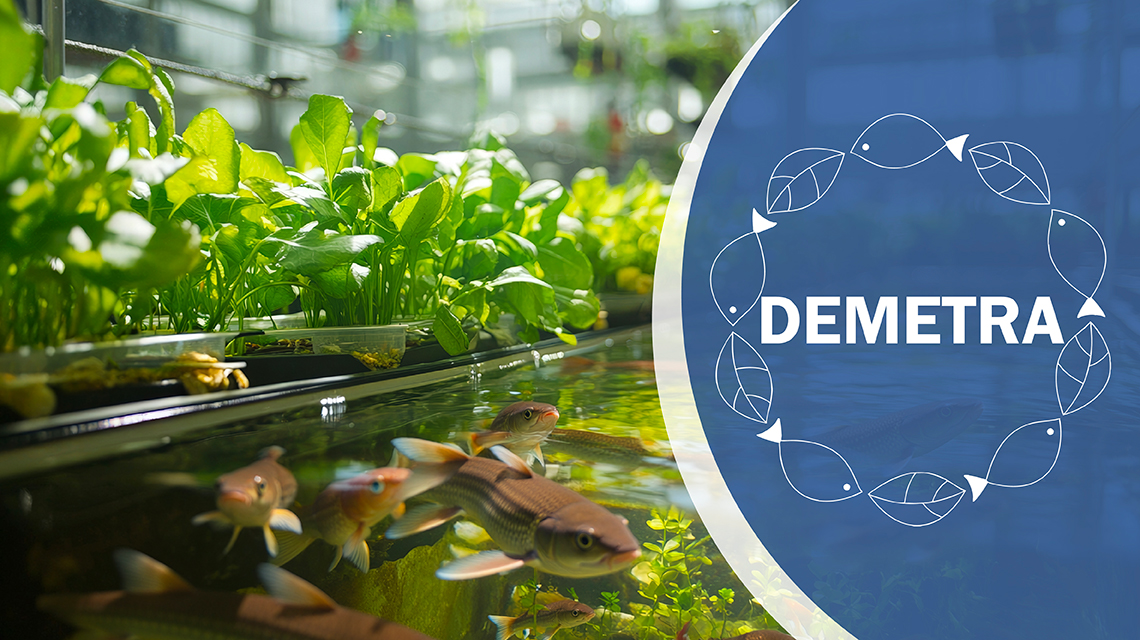
Developing a high-tech system for producing vegetables, fruit and fish with low environmental impact in urban, disused and school environments thanks to aquaponics, a technology combining aquaculture and hydroponics (soilless plant cultivation), is the objective of the project DEMETRA[1], funded by the Ministry of Enterprise and Made in Italy with over €5 million. The project involves ENEA, which collaborates with the Federico II University of Naples, the CAISIAL consortium, and the companies FOS (lead partner), IRCI and Grafica Metelliana.
The DEMETRA project aims at creating two low-cost, modular and scalable prototypes: an industrial platform for large-scale production of fresh food in urban farms; a more compact platform for domestic use, intended for canteens, restaurants, apartment buildings or nursing homes. This mini community plant is designed to provide fresh, high-quality animal and plant proteins directly to users and can also be used by restaurants or agritourism businesses to promote zero-kilometer production (from farm to fork). Both systems will be built on a prototype and demonstration scale (with a TRL7 level of technological maturity) and will be tested at the IRCI Spa, an industrial partner specializing in hydroponic and aquaponic systems. The domestic version will be a miniature of the industrial model, with a reduced number of subsystems. The experiments will continue to take place underground in the city of Naples: the industrial model will be installed in a cavity in the Galleria Borbonica.
“For crop cultivation, we are considering chili peppers, a plant easy to cultivate, resistant to disease, and whose by-products fibers can be utilized to produce bio-packaging materials, used to package and sell the food produced in the plant,” explained ENEA project coordinator Salvatore Dimatteo, a researcher at the Regenerative Circular Bioeconomy Laboratory. “As for fish species,” he said “we are considering eels due to their high adaptability”.
The project will adopt the best management practices for for animal welfare, through a network of IoT sensors and advanced control technologies providing early warning on water quality, automatic and intelligent decisions for the administration of food and nutrients, prediction of fish and plant diseases, food safety verification and remote control and diagnosis.
The plant will operate under the principle of circularity, with zero waste, where fish waste from the farm becomes essential nutrients for plant growth. Elements like nitrogen and phosphorus, derived both from fish excrement and decomposition of uneaten feed, will be purified through a biofilter containing bacterial colonies, converting nitrites to nitrates, which are then assimilated by the plants. The filters and aeration will also serve to lower the amount of suspended solids to the highest degree possible, to keep the water quality at an acceptable level and prevent poor oxygenation.
The aquaponics system will be integrated with a rainwater collection and storage system reducing water consumption by up to 90% compared to traditional agriculture, will create a self-sustaining eco-system. In addition, it will not require the use of pesticides or herbicides, thus improving environmental protection and food safety.
On the energy front, the aquaponics platform will use a system generating and storing electricity from photovoltaics to power water, air and lighting systems, which will be low energy consumption.
The prototype will be equipped with a microalgae cultivation system (Spirulina and Chlorella), highly effective in aquaponics for improving water quality. “In addition to microalgae cultivation, we also intend to integrate insect farming like mealworms (Tenebrio molitor), to produce protein meal for fish feed” said Dimatteo.
The DEMETRA project also involves the design of a small-scale biorefinery for producing bioactive compounds from vegetable, fish, insect and algae waste. “These molecules can then be used to create new functional foods managing hypercholesterolemia, thyroidism and hypertension”, concluded the ENEA researcher.